Showing posts with label functional communication training. Show all posts

Tuesday, December 3, 2024

Best Blog Posts for Communication

To start this school year, our team is compiling some of our best examples of supports we have seen in our districts and featured in previous blog posts. Today we are highlighting all of the Best Blog Posts for Communication. 


Click on the hyperlink under each heading below to be taken to the related post on that topic.


Tuesday, December 19, 2023

Communication Corner: Modeling and Facilitating Core Words Across the Day

Teaching core words is an important step in developing functional communication. When we go out into districts we see so many ways to model and facilitate the use of core words in natural ways. The adults should model the use of core words all the time in order for students to learn functional use of the words. 


In today's Communication Corner we will highlight ideas for Modeling and Facilitating Core Words Across the Day. 


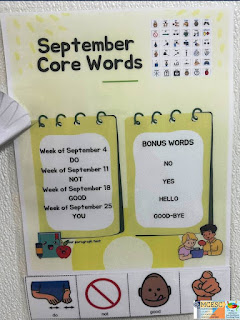
Provide access to core words in the classroom with core word boards posted on the walls in key locations of the room.

Laura Windholtz
Learning Center West, MCESC


Lisa Turner
Mad River ECC, Mad River

Carla Bryant
Miamisburg

Maddie Boyd
Park Layne Elementary, Tecumseh


Directly teach new words and provide ample opportunities for practice. 

Heather Clark
Saville Elementary, Mad River

Ann-Marie Small
Driscoll Elementary, Centerville


Provide access to core words on the go!

Laura Windholtz
Learning Center West, MCESC


 Provide access to core words on the playground.


Jessica Wright
Smith Elementary, Oakwood

Jessica Wright
Smith Elementary, Oakwood

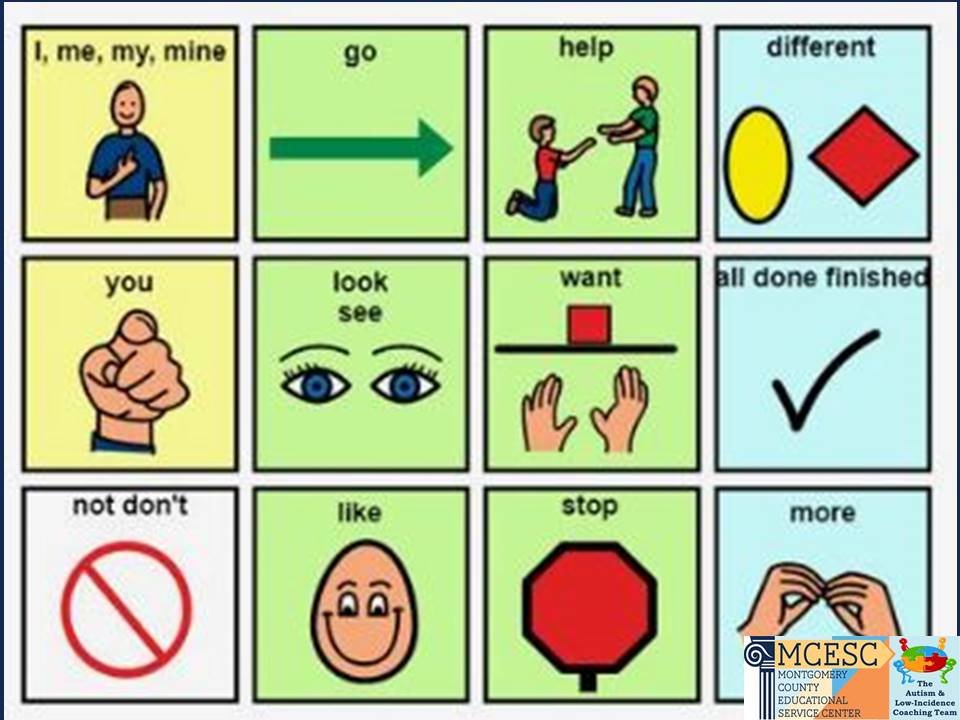
If a student is going to be using a communication device but does not always have access to it,  print and laminate a copy of the core home page to provide easy access in the classroom and on the go. You can take a picture of the home page or find it online. This way the student can practice using the same pictures in the same locations as they will on their device.


Post reminders for the staff to model and facilitate target words.


Laura Windholtz
Learning Center West, MCESC

Laura Windholtz
Learning Center West, MCESC


Laura Windholtz
Learning Center West, MCESC


Taylor Ruef
Stevenson Elementary, Mad River

Ann-Marie Small
Driscoll Elementary, Centerville


If you need to expand the core board or add fringe words, consider creating a flipbook.


Carla Bryant
Miamisburg

Carla Bryant
Miamisburg


You can also add fringe words by posting choice boards in key locations of the room.


Michelle Wade
Northridge Elementary, Northridge


If you have a static display voice output device such as a Go Talk or Tech Speak you can create a core page and have a section where you can insert different fringe words as needed. This way the core words are always in the same location. This Tech Speak overlay was created to practice core words during fun interactive activities such as playing with blocks or blowing up and letting go of a balloon.


How do you model and practice functional use of core words in your classroom? Visit our Communication Corner blog on Core Words for more ideas! 

Communication Corner: Core Words
Tuesday, October 25, 2022

Sensational Social Skills: The Foundation for Building Reciprocal Communication

Building the foundation for reciprocal communication is important at all levels of communication.


Are you working with a nonverbal student who is just beginning to develop basic skills such as maintaining attention to an activity, parallel play, and joint attention with a partner?

Are you working with a verbal student who struggles with conversational skills and body language?

No matter the level you always need to look at the foundation. Today's Sensational Social Skills will examine each part of this essential foundation and provide a variety of examples from our regional classrooms!


The Foundation

In the book, Social Engagement & the Steps to Being Social, (Taylor & Laurel 2016) the importance of creating a foundation on which to build all reciprocal communication and social engagement is illustrated. It is important to monitor and support the foundation when working on developing communication and social skills. We organized the foundational supports into 3 categories:

  • Regulation- If your student is dysregulated, they may not be available for engaging at any level. Monitor your student’s regulation by considering the following:
    • Environmental Distractions (reduce visual and auditory distractions)
    • Space (reduce the space by creating visual and physical boundaries)
Rylie Jarrett
Stevenson Elementary, Mad River

    • Organization (organize the space and develop a predictable routine for interaction)
Rachel Hatton
Normandy Elementary, Centerville


    • Biological (your student may be thirsty, hungry, tired, hot, or cold)
    • Sensory Input (incorporate movement or deep pressure/heavy work)
Heidi Horner
Miami County ESC

Heidi Horner
Miami County ESC


    • Emotional State (find out what your student is upset about to validate and provide encouragement)
Wh-Question Flipbook

    • Touch (avoid unexpected touch or too much hand-over-hand prompting)
    • Slow it down (just sit quietly and wait allowing pauses in the activity)


  • Motivation- It is hard to gain joint attention when the student has no interest in the activity. Try to develop shared pleasure in the activity:
    • If your student is verbal. Ask questions or just listen to find out their interests. Incorporate these interests into the activity.
    • Build interest by incorporating humor and playful fun into your activity.
    • If your student is nonverbal, discover what they like by presenting a variety of activities. Follow their lead. Model the activity with animated gestures and sounds/words. Imitate their actions or sounds.


Paula Taulbee
Mad River ECEC, Mad River


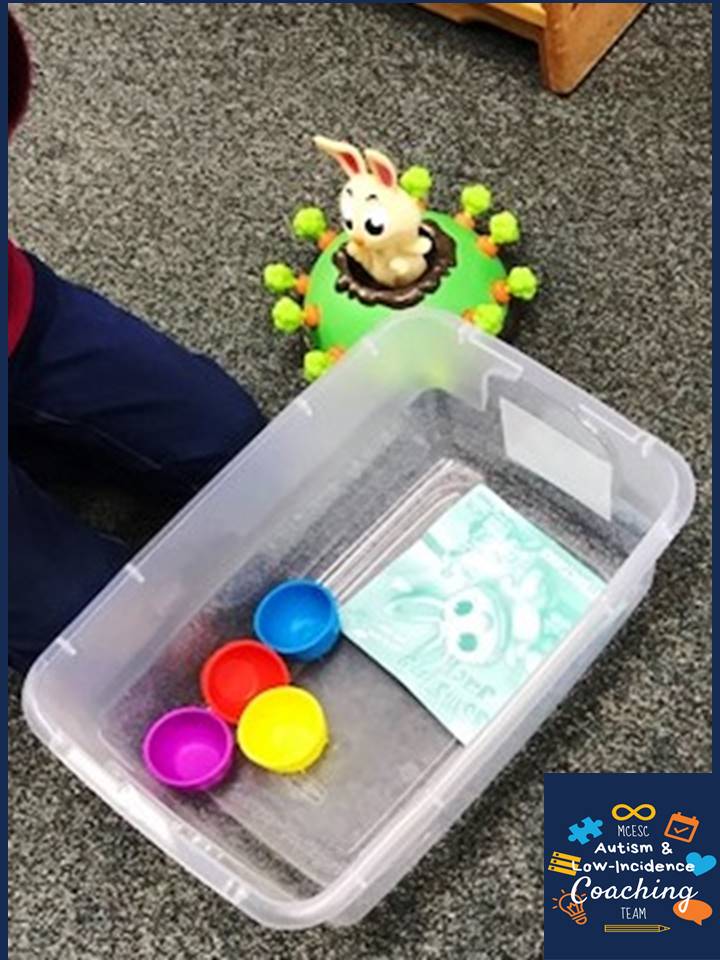
    • Building anticipation can peak interest. Consider games that build anticipation such as these:
Beth Young
Snyder Park Elementary, Springfield


    • Do an interests inventory or send home a parent questionnaire to identify student interests. Click the image below to get a free reinforcement checklist to send home to parents:
    • Develop a plan to reinforce reciprocal interaction.


  • Self-Management- Even when they are regulated and motivated, your students may struggle to be purposeful in their actions. A study by Kogel, Park, & Kogel (2014) found that self-management supports and interventions were effective in increasing reciprocal social conversation for students on the autism spectrum. Self-management supports and interventions may include:
    • Predictable routines with clear expectations
    • Repeated practice in a fun structured setting with transfer to other settings
    • Priming
Jackie Vollmer
Driscoll Elementary, Centerville

    • Peer Mentor Modeling
Mandy Violet
Brantwood Elementary, Mad River

Casey Morter
Mad River ECEC, Mad River


    • Visual Cues for verbal language and nonverbal expectations
      • Sentence Strips to cue scripts 


      • Picture prompts 
Amy D'Amico
MCESC, Learning Center- North


      • Schedules/Checklists 
Kristina Neuhart
Mad River ECEC, Mad River


    • Cognitive Behavioral Intervention to develop self-awareness/advocacy and awareness of others. Visit our Sensational Social Skills Blog for ideas. Click the images below to find our Respond to Others post with corresponding handouts!


Remember: When working on building reciprocal communication skills at any level, always check the foundation and modify your support and the demands as needed for the student to succeed. Check out these examples of students engaged in reciprocal communication. They are regulated and sharing pleasure in a joint activity with an adult or peer.


Miranda Riggs
Mad River ECEC, Mad River

Erika Lauterbach
Dixie Elementary, New Lebanon

Greenville Middle School

Heidi Horner
Miami County ESC