Last year we had the pleasure of meeting Haley Urschel at Perrin Woods in Springfield Schools during her first year of teaching in a low-incidence classroom. Right away we were impressed with her leadership skills, organization, paraprofessional management, and data collection. As we had more time working with Haley we found she was a great partner to the ACT team. She implemented recommendations with fidelity while making them her own so they would work best in her classroom and she worked hard to collaborate and communicate across all team members. She also advocated for her students' needs and saw the importance of skill development rather than punitive consequences. It was not hard for us to decide that Haley should be inducted into our A-LIST last spring! Today we are excited to feature her in our A-LIST Spotlight.
When we reached out to Haley to contribute to today's post she went above and beyond. Keep reading to learn more about the supports she shared from her classroom:
Classroom Overview
My students this year are
much more advanced on the Autism spectrum than the students had last year. They
are all in the process of transitioning to be in general education classes at
least part time. As a result, I have tried to give students exposure to things
that they see in the general education setting and help find resources that
easily able to be transferred to the general education setting. Many of the
resources that I am including may not look as if they are specifically geared
to students with Autism, but they are the supports that my students need to be
successful. A lot of my resources are things I created for myself as a teacher
and to help me better collaborate with other teachers and my classroom team.
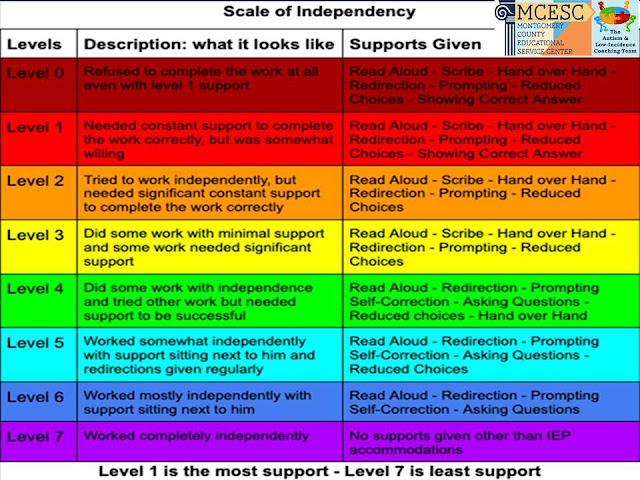
Scale of IndependencyThis is
a resource I created for my classroom to help me track student progress towards
their goals. My students often refuse to attempt an assignment if it is a new
concept or is something they don’t want to do. If they are willing, sometimes
they rush through or don’t give something their full effort and I know that. In
my classroom, I was seeing growth in students doing more work on their own and
being more willing to try something, but it wasn’t being reflected in their
“correct answer” scores on their work. I wanted a way to track progress. This
scale helps me easily record how much support a student needed on an
assignment. When a student completes an assignment, I write LOI# (using the
number that corresponds to their level at the time), to track their Level of
Independency. The supports given is just a generalized list that is more
specific to my students. I included that in the chart to allow the
paraprofessionals in my room to help me track this when students are working.
It allowed us as a team to be more consistent in the levels we were observing
in students. This chart is somewhat specific to students in my classroom, so
another teacher may have to tweek it, especially in the area of supports given.
I have found it to be incredibly helpful when I am looking back at work,
especially on IEP data, to know whether a student got 20% correct with me
walking them through each step, or whether they got 20% correct doing the
assignment on their own.
ELA and Math Rotations
I
created these magnetic labels (and more) and magnetic initials for my students
that allow them to move their card to the rotation that they are on. This helps
them when they are trying to independently get to a website on their Ipad
because they kind find their name and look at how the website is spelled to
find it on their Ipad. This allows my team to keep track of what students are
supposed to be doing and helps me to have time to work with students
individually or in small groups while other students are still staying on task
and learning with the support of my classroom team. I just returned from
maternity leave and have been trying to create the resources I need for the
room as quickly as possible, I would like to add a picture of what the App for
each website looks like next to the name and get the apps added to each
student’s Ipad so they can be even more independent.
Individualized Student Work Charts
Students in my
class need different kinds of work charts to meet their individual needs. I am
still in the process of figuring out the best work chart for some of my
students who are new to my class. Here are examples of what I use with a couple
of my students. The first one, I created and laminated to allow students to
cross off each thing as they did it each day.
The second one is a chart that I got from the ACT team last year that we
use with a student all throughout the day. The last one I created is for a
student who loves to read, but likes the pictures. We defined what “good
choices” look like for her. Each work time she chooses “work time” and 2 other
“good choices” she wants to work on to earn her choice reward. If it is not a
work time, she chooses 3 “good choices” to focus on to earn a reward. The goal
is for her to eventually work up to having 5 “good choices” that she is doing
at a time. It has helped her to know what is expected and to see how she is
doing at following expectations.


Behavior Tracking Sheets
Here are some
various tracking sheets I created to help me easily gather behavioral data for
students. The first is for a student that was being very aggressive and was
non-verbal. We wanted to try to find the antecedent to the hitting. The second
tracker I use to track a student’s zones throughout the day to help us find
patterns there. The last one is to track a student who has a lot of different
off-task behaviors during work. We use it to see how many times we have to
redirect as we try various different interventions to see which are working
best.
Classroom Contract
Since my students
this year are better readers and have higher-level comprehension skills, I
decided to have them do a classroom contract with me. I asked students what
their goal was for the rest of the year and I wrote that down on their paper.
Then I told them what my goal for them is this year. We then developed a “plan”
for how we are going to make it happen. It has really helped students to take
ownership of their behavior and I regularly revisit their goals with them.
Learning Targets
I used a
combination of words and pictures for student learning targets. I write out
learning targets as simply as possible to cover the grade-level standard we are
working towards as a class. I included the grade-level standard for each
student’s grade in my own lesson plans, but the students only need to see the
big picture we are working on as a class.
Lists for Each Teacher
I created
individualized resource sheets about each of my students to give to general
education teachers who may have my students in class. It is just a short list
of things that will help the teacher quickly learn something about my student
without having to look through their whole IEP.
Individualized Break Cards
I have been
working on individualize break cards for each of my students. I am teaching
them how to use them in class so that they can have them available and know how
to use them in a classroom setting. This obviously isn’t a new idea, I just
have found it to be more successful when students like the break card itself.
Weekly Team Reflection Sheet
I started this
last year with my team to support classroom communication and problem-solving.
It is hard to sometimes find time to fill it out as a team, but it helps us to be
reflective in educators and make decisions about what we can do to make our
classroom better meet the needs of students. It also gives us a chance to
reflect upon the successes we are seeing and celebrate those.
A huge shoutout to Haley for sharing these fabulous supports! We have loved working with you and are so happy that you are part of our A-LIST!
.png)