Showing posts with label therapists. Show all posts

Wednesday, May 6, 2020

Regulation Rendezvous: Self-Care During the Coronavirus Pandemic

We know that this time of quarantine has been difficult to manage for so many. It can be easy to become overwhelmed with the ever-changing demands of remote learning, managing family needs, and keeping everyone safe and healthy. It is important though to provide care for yourself so that you can provide for others. In today’s Regulation Rendezvous we will be sharing ideas for Self-Care during the Coronavirus Pandemic. 


We love this graphic from Pathway 2 Success which provides some great ways to proactively take care of yourself during the pandemic. Sometimes you may get so wrapped up in troubleshooting everything that is making life challenging that it can be hard to make time to do something that makes you feel good. But thoughtfully making time for self-care strategies will help to keep your body and mind healthy. 


But what do you do when you start to feel overwhelmed? This is a natural feeling for everyone during these stressful times no matter how proactive you try to be. First, be kind to yourself! Acknowledge your feelings of overwhelm and be mindful in your response. Save this great free poster from Whole Hearted School Counseling where you can easily access it when you need to take a moment to reflect on how you are feeling. 


Regular practice of self-care strategies makes it easier for you to apply these strategies when feeling overwhelmed or anxious. Check out our previous posts for strategies to try:


Apps are another great way to keep track of changing emotions and to easily find self-care strategies such as breathing or meditation. Click on the images below to learn more about some of our favorite self-care apps:


 Youper
Youper
Mindshift CBT
Welltrack
Moodpath
Self-Help for Anxiety Management


Friday, April 12, 2019

Executive Functioning Forum-- Problem Solving

Problem Solving is a complex skill that can be challenging for many students, especially those with trouble managing their executive function and emotional regulation skills. They may not realize there is a problem that needs solved or they may have difficulty entertaining more than one possible solution. They may have a tendency to focus on one aspect of a problem, to the exclusion of other components. Sometimes this includes and inability to identify the most important parts of the problem. Furthermore, they may hyper-focus on the problem even after it has been solved and may be resistant to asking for help from others. Also, they have a tendency to become “stuck” on one solution and won’t try other possible strategies. They have difficulty generalizing skills and knowledge to other situations and environments. Today's Executive Functioning Forum provides a variety of strategies for addressing these deficits through direct instruction of problem solving skills. 


Teach Students to Ask for Help
In the earliest stages of problem solving, students may need to learn to ask for help so that someone can help walk them through the problem and possible solutions. Provide a routine, predictable way for them to ask for help and provide opportunities for practice. Help them to understand when they are feeling overwhelmed or confused they should initiate asking for help. Incorporate visual supports and reinforce their willingness to accept help.
Jamie Minnish
Prass Elementary, Kettering

Jamie Minnish
Prass Elementary, Kettering


Practice a Calming Strategy
It is difficult to problem solve when feelings of anxiety and frustration take over. Directly teach and deliberately practice calming strategies that students can use in the moment to help them calm down before proceeding with their problem solving techniques.  
Elisha Volp
Northridge Elementary, Northeastern

Marie Reikowski
Demmitt Elementary, Vandalia

Laurie Maravetz
Schaefer Middle School, Springfield


Help Students See Their Options
Use visual supports to help students see what their options for solving the problem may be and the consequences of each choice. Initially you may focus on a positive (green) and negative (red) option and gradually expand upon the options to include all of the possible solutions and consequences. Use visual supports to illustrate this thought process and to provide the information in a familiar, predictable way. Later the strategy of thinking through possible solutions can be done more independently with a blank visual support. 
Taylor Ruef
Stevenson Elementary, Mad River


Emily Ottmar
Stevenson Elementary, Mad River


Teach Students to Think About Their Thinking
Metacognition is the awareness and understanding of one's own though processes. For students who struggle with executive functioning, metacognition can be especially difficult. Model your own thought processes and provide questions that help students to thinking about their thinking. 
Leslie Mann
Smith Middle School, Vandalia


Bring It All Together
Once students have been taught these processes in isolation, bring them all together through use of a cumulative visual support that can be used for priming them before challenging situations and that they can use in the moment to help them work through a problem.
FLIPP The Switch: Strengthen Executive Functioning Skills

Leslie Mann
Smith Middle School, Vandalia

adapted from Successful Problem-Solving for High-Functioning Students with Autism Spectrum Disorders

For more ideas on meeting the needs of students with executive functioning difficulties, check out our previous Executive Functioning Forum posts. 

Friday, August 17, 2018

Regulation Rendezvous-- Calming Classroom Environment

Dealing with the myriad of sensory information within the school setting can be very challenging for a student with autism. When a student with autism experiences sensory overload, (s)he may have a behavioral meltdown. One strategy to avoid or reduce the likelihood of meltdowns is to create a Calming Classroom Environment. Today's Regulation Rendezvous will provide 5 easy steps to creating a calmer classroom environment.


1. Provide Comfortable Seating Options
Options can be provided for when students are completing work or when they are taking a break between activities. 
Kelly Sewell
Kleptz ELC, Northmont

Khristie Reed
Kettering Middle School, Kettering

Jordan Bauman
Baker Middle School, Fairborn

Karen Shires
Valley Elementary, Beavercreek

Rachel Hatton
Normandy Elementary, Centerville

Kate Pennington
Kettering ECEC, Kettering


2. Reduce Visual Clutter
Limit the amount of visual clutter hanging on the walls so students do not become visually distracted or overwhelmed. 
Kelly Sewell
Kleptz ELC, Northmont

Cover shelving with simple fabric in calming colors with little or no pattern.
Katy Boston
Morton Middle School, Vandalia


Traci Parker
Forest Elementary, Troy

Stephanie Foreman
South Vienna Elementary, Northeastern

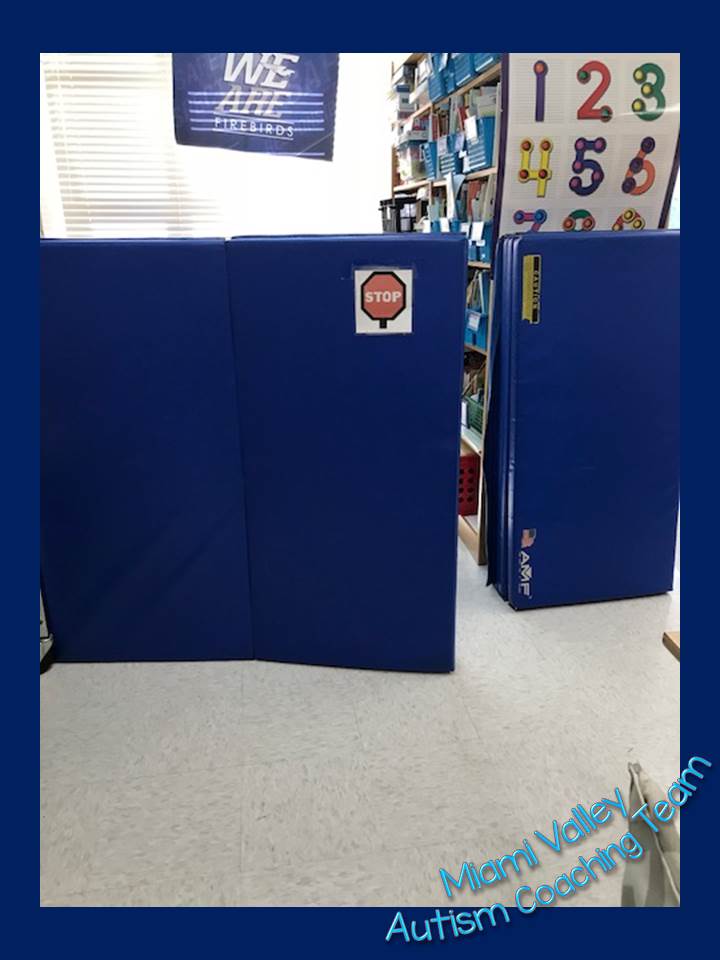
Use portable dividers to further reduce distractions during times when students need to focus. 
Laurie Maravetz
Schaefer Middle School, Springfield

Christine Scarborough
Tecumseh Elementary, Xenia

Brittany Sword
Valley Elementary, Beavercreek

Jamie Minnish
Prass Elementary, Kettering

Sarah Moore
Warder Park Wayne, Springfield


Beth Young
Snyder Park Elementary, Springfield


3. Use Dim Lighting
Kelly Sewell
Kleptz ELC, Northmont

Denise Sanders
Hollingsworth Elementary, Eaton


Rachel Hatton
Normandy Elementary, Centerville


Gail Wright
Eastmont Elementary, Dayton
Taylor Ruef
Stevenson Elementary, Mad River


Sandy Beck
Broadway Elementary, Tipp City

Athenia Eversole
Versailles Elementary, Versailles

4. Provide Sensory Neutral Space for Sensory Breaks
Amy Beanblossom
Arcanum Elementary, Arcanum

Keelin DiMuccio
Fairbrook Elementary, Beavercreek

Angela Crum
Parkwood Elementary, Beavercreek


5. Avoid Auditory Clutter
Use visuals such as visual schedules or cue cards to limit the amount of auditory clutter from talking and redirections.


Taylor Ruef
Stevenson Elementary, Mad River

Gail Wright
Eastmont Elementary, Dayton

Kendall Koehler
Normandy Elementary, Centerville
Also, playing calming background music during quiet work times can help to block out other distracting noises. Use Youtube or a music streaming site to find music using search terms such as: acoustic, meditation, nature sounds, binaural beats, 60-80bpm.