Showing posts with label attention. Show all posts

Tuesday, February 27, 2024

Sensational Social Skills: Building Joint Attention During Instruction

Do you have a student who is hard to engage during instruction? Today's Sensational Social Skills post  will focus on Joint Attention strategies to help your students engage with you so you can teach them new skills. 

If you haven’t already seen our blog on the Foundation for Building Reciprocal Communication, check it out here: 

The Foundation for Building Reciprocal Communication

This blog will talk about the first steps when trying to engage with your student. Before you can expect your student to engage with you for instruction, you need to develop motivation, regulation, and basic self-management.


Once you have taken the time to build the foundation, you can determine what you want to teach your student and how to gain joint attention for the lesson. If your student struggles with joint attention, you want to start with something easy to build momentum.


One example is a preschool student who was new to the school environment. He struggled to engage with the adults and constantly tried to escape the environment and throw any item placed in his space.

  • The first goal was to create a space that provided clear visual and physical boundaries. A wide open space makes joint attention a challenge. Help to narrow the area the student is attending to at the moment using visual screens or strategically placed furniture. A cube chair provided physical boundaries. 
Lisa Turner & Katie Mlod
Mad River ECC, Mad River


  • Once this was established, the team focused on teaching the student to take the item placed in front of him, and instead of throwing it across the room, to place it in a bin. 
Denise Campbell
Mad River ECC, Mad River

  • Soon the student learned to pull a picture off Velcro and put it in a bin. Only one picture was on the page so it was an errorless task.

  • After practicing this basic skills in a structured environment, the student was able to participate during the preschool morning circle using an interactive circle time book.
Miranda Riggs
Mad River ECC, Mad River


Here are some other examples of strategies to support joint attention during instruction:

  • Use furniture to create physical boundaries 
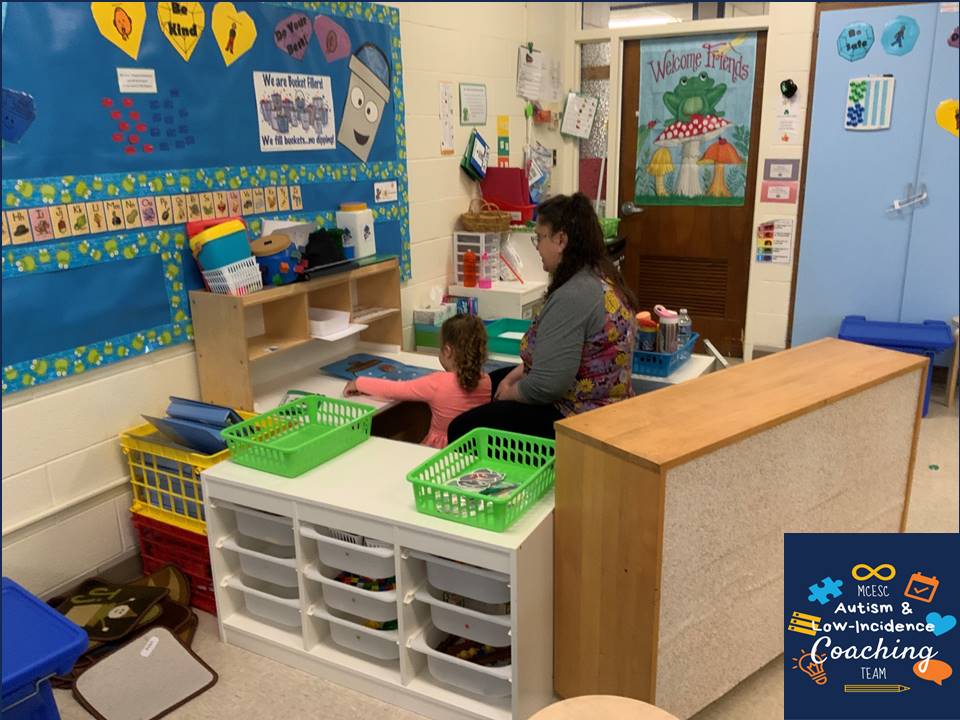
Debi Gnau
Mad River ECC, Mad River

  • Use a bead box or pillbox to provide small edible treats for task completion. The student can match letters, numbers, or words to get a treat. These small edible reinforcers can allow quick and frequent reinforcement of those challenging or non-preferred tasks.
Debi Gnau
Mad River ECC, Mad River


  • Incorporate a fun anticipatory game to gain joint attention during instruction. For example, if using Pop-up Pirate or Jumping Jack (pictured below), the student gets to put in a sword or pull out a carrot for each small task. The anticipation of something popping unexpectedly may keep them engaged. 
Beth Young
Snyder Park Elementary, Springfield


  • Add personal interest information to assignments such as worksheets, taskboxes, or other activities
Dixie Middle School, New Lebanon

Michelle Barnhart
Bell Creek Intermediate, Bellbrook-Sugarcreek

Michelle Wade
Northridge Elementary, Northridge

Tim Cundiff
Greenville High School, Greenville


  • Prior to or during  instruction, gain joint attention through face-to-face physical interaction with  high-fives or these classic hand games: Patty Cake, Say Say Oh Playmate, Hand Slap


 Check out this article with more ideas and video examples:

 Care.com 8 Easy Hand Games for Kids


  • During whole group instruction or passive listening, provide instructional visuals for the student to manipulate.  
Rose Jepson
Northridge Elementary, Northridge

Makayla Barbar
Mad River ECC, Mad River

Genevieve Harvey
Walter Shade ECC, West Carrollton

Angie Whip
Northwestern Preschool, Northwestern

Amy Beanblossom
Arcanum-Butler, Arcanum


  • For non-speaking students, it is important to provide communication supports so that they have needed vocabulary readily available to engage in the activity. 
Emily Ottmar
Stevenson Elementary, Mad River


  • During instruction, use a pointer or light to direct the learner’s gaze to the target.

Try some of these strategies with your hard to engage student. It may take multiple tries before a strategy becomes effective. Keep in mind that what works for one learner may not work for all. And finally, always remember your foundation for joint attention: regulation, motivation, and basic self-management.

Monday, April 22, 2019

Regulation Rendezvous-- Top 3 Tips for Implementing Fidgets with Success

Have you tried implementing the use of fidgets in your classroom but find them to be more of a distraction than a benefit? You are not alone! Many of the teams we coach have had difficulty implementing fidgets successfully. But not to worry! In today's Regulation Rendezvous we will provide our Top 3 Tips for Successfully Implementing Fidgets in the Classroom.


Tip #1: Teach Students How To Use a Fidget
If a student is provided with a fidget without any direct instruction on how to use it, often times it becomes a toy. Instead of using Theraputty to squeeze in their hand while listening to instructions, they may start to make shapes and figures with it. Establish rules for proper use of the fidget and emphasize that not following those rules results in the fidget being put away. Rules may include how to use the fidget (including not playing with or destroying it), how to avoid distracting others with the fidget, and how to clean up when asked. For a student who struggles with throwing fidgets you can attach them to a lapboard like the one below.

Amanda Dull
Northmoor Elementary, Northmont


Tip #2: Teach Students When To Use a Fidget
During instruction, fidgets can be used to help students listen during stories or when explaining concepts. They can also be used to help students focus when working on assignments. Typically these fidgets would be less visually interesting and may be more tactile so that they do not become a distraction.

Pam Ellender
Mad River Middle School, Mad River
Brenda Cogan
Kettering Middle School, Kettering

Sometimes fidgets are helpful for students to use when taking a break to calm down or ease anxiety. Fidgets that are more visually engaging such as sensory bottles or mermaid sequins may be allowed during these times because they can distract students from what is causing them to become upset.
Bobbi Jo Chapman
Snyder Park Elementary, Springfield

Christine Scarborough
Tecumseh Elementary, Xenia

Jackie Vollmer
Driscoll Elementary, Centerville

Mandy Whitfield
MCESC Learning Center- East, MCESC


Tip #3: Help Students Understand Which Fidgets Work Best for Them
Different fidgets work for different students. Help students understand their sensory preferences and which fidgets work best for them. For instance, students who are prone to pick at their clothing, items taped to their desk, or their fingers may benefit from a fabric box where they can pick strings off fabric swatches.
Pam Ellender
Mad River Middle School, Mad River


Then develop individualized toolboxes for each student to use when needed.
Susan Trissell
Westwood Elementary, Dayton

Mandy Whitfield
MCESC Learning Center- East, MCESC

Wednesday, April 17, 2019

Communication Corner-- Engage in Social Routines

Persistent deficits in social communication is one of the hallmark diagnositc criterion for individuals diagnosed with autism. Therefore, this is an important area to focus on when designing interventions and when implementing functional communication training. Today's Communication Corner covers a wide range of social routines and ways to implement interventions within the classroom.

Sensory Social Routines
For some students, it may be necessary to begin working on social routines through simply gaining joint attention in an engaging way so the student develops social awareness. Repetitive songs and games with gestures are a great place to start such as Peekaboo, Wheels on the Bus, or Pat-a-Cake.


There are many gross motor games that can also be played to keep students engaged in the social routine such as Red Light, Green Light or Dance Freeze.


Sensory Social Routines with Objects
Incorporating objects into social routines is another great way to engage students to attend to the adult. Initially model the actions and phrases several times so the student understands the expectation, then use expectant waiting and pause to cue students to join in. For instance, when playing with cars on a track, model "1...2...3...GO!" and then release the car to go. After several models, set up the cars and say "1...2...3.........." and wait for the student to say "GO!"


Incorporate special interests or favorite toys to keep the student engaged such as balloons, water play, trains, marble runs, wind up toys, or musical toys.

There are many anticipatory games that can also be incorporated for 1:1 instruction or when working on turn taking with a small group such as Crocodile Dentist, Don't Wake Daddy, Pop Up Pirate, Dino Meal, Kerplunk, and Don't Break the Ice.

Beth Young
Snyder Park Elementary, Springfield
Scripts for Social Routines
As students begin attending more readily to others, begin to incorporate social greetings and common phrases using scripts. Sentence strips can be made to cue students in the moment.


Provide many opportunities to practice within the classroom.

Rachel Hatton
Normandy Elementary, Centerville

Carrie Prickett
Jane Chance Elementary, Miamisburg

You can also provide opportunities to generalize this skill by having students visit office staff or other school staff members to make deliveries and practice greetings.


To prevent students from becoming too robotic with their greetings and to keep it fun, introduce a variety of ways to greet others including slang, gestures such as handshakes, fist bumps, or high fives, and seasonal greetings and routines.


For more ideas on functional communication training skills check out our previous Communication Corner posts:


Thursday, March 21, 2019

Regulation Rendezvous- Top 3 Tips for Adaptive Seating

Today many classrooms require students to be seated throughout a majority of their school day. This can be quite a challenge for our students with sensory processing differences. Follow these Top 3 Tips for adaptive seating to help your students stay regulated when they need to be seated.


1. Provide Physical Boundaries
Some students may have proprioceptive processing difficulty which can make it challenging for them to know where their body is in space. This can lead to them invading the space of others and can make it difficult to stay in one area. Physical boundaries give the student a defined area and can help them feel more secure. 

When seated at a desk or carpet, use arm rests to provide a physical boundary. Seating like a wooden Rifton chair or a Zuma chair with arm rests are great options that we often see. 


Rylie Jarrett & Denise Campbell
Stevenson Elementary, Mad River

When seated at the carpet, physical boundaries can be provided using a cube chair or for some even a carpet square can help keep them where they need to be. 


Kathy Timmerman
Fairbrook Elementary, Beavercreek


2. Allow for Movement
Many of our students actively seek vestibular movement throughout the day. They may rock in their chair or need to get up and pace. Providing seating options that allow for movement can help them be more focused. 

For desk or table work, we love these Zuma rockers that look like a typical school chair but have rounded legs to allow for rocking. 

Edison Elementary, Dayton

We have also seen an increase in classrooms using standing desks which can help students move around to stay engaged and alert. For students who need extra movement while at a standing desk, tape a box on the floor to provide a boundary for where they can pace. 

Annette Stine
Kyle Elementary, Troy


Tami Bartley
Fairborn Primary, Fairborn

We love this great use of a cocktail table to provide a standing option for students. 
Khristie Reed
Kettering Middle School, Kettering

At the carpet, scoop rockers or rocking gamer chairs can be great options. 


Bobbi Jo Chapman
Snyder Park Elementary, Springfield


Brittany Bush
Spinning Hills Middle School, Mad River


3. Give Support
It is important to make sure students are supported when seated. Without support, students can become distracted and uncomfortable. The effort needed for completing work may be too much if they are also actively trying to manage their discomfort. 

Many of our students have limited core strength and need their trunks supported when seated at the carpet. They may slouch, lean, W sit, extend their legs straight out, or lay down if seated for too long without support. These students may also appear restless and reposition often as they try to manage the seated position. Giving support to their trunk through providing a back rest can be a great way to keep them more engaged. 

Howda Hug Chair


Alisa Hartlage
Northridge Elementary, Northeastern

Ramel Mitchell
Kyle Elementary, Troy
On the carpet, some student may also struggle with completing work in their laps. Allowing them to lay on their stomachs to work or providing a floor or lap desk can be great alternatives. 
Brittany Sword
Valley Elementary, Beavercreek


It can often be difficult to find classroom chairs that are the correct size for all students. But this is so important because dangling legs can not only be uncomfortable but it can also effect blood circulation. Giving support ensures that stress on the student's muscles and joints is evenly distributed across their body.  Lack of support can cause increased strain on their body which can lead to fatigue, tight or achy muscles, joint stiffness and even pain. This can lead to students frequently repositioning and folding their legs up in the chair. Sometimes we see students wrapping their feet around the legs of the chair also. If you cannot obtain chairs at the correct size for each student, providing foot rests can be a great solution. These can be easily made using wood, boxes, or phone books wrapped in duct tape. 

Pam Ellender
Mad River Middle School, Mad River

There is no one-size-fits-all approach for adaptive seating and many classrooms have to differentiate to meet the unique needs of each student. We love this classroom's use of cube chairs, student chairs, rocking chairs, and even a cube chair wrapped in a body sock to make sure all of their students are able to engage in carpet time more readily!
Keelin DiMuccio
Fairbrook Elementary, Beavercreek

And how this classroom added weights to a student's chair so that she can get heavy work input by moving her chair from center to center.
Emily Colbert
Bruce Elementary, Eaton


For more ideas on meeting your students' seating needs check out our previous post on Preferential Seating.