Showing posts with label ADHD. Show all posts

Thursday, December 3, 2020

Regulation Rendezvous: Class-wide and Individual Proactively Scheduled Sensory Breaks

School can be overwhelming for students, especially those with autism or low-incidence disabilities. It can be very sensory-rich and full of demands. To help students stay regulated, focused, and ready to learn, it is important to proactively schedule sensory breaks throughout the school day to address sensory needs and provide a break from various demands. Because they promote self-regulation, sensory breaks should not be contingent upon behavior or work completion. Sensory breaks can be beneficial as a class-wide and/or individual support. They may occur within the classroom or in another designated location. Today's Regulation Rendezvous will provide a variety of sensory break ideas from our referral districts. These recommendations will be organized by class-wide breaks that can be done with a group of students, individual breaks within the classroom in which the student takes a break at their desk or in an area of the classroom, or individual pull-out breaks where students are taken out of the classroom to a separate location. 


Movement Breaks

Movement breaks can be a great way to meet student sensory needs when they seek vestibular input or if they have been inactive or seated for long periods of time. 

Class-wide Breaks: We often hear these breaks referred to as "brain breaks" in the classroom. They can be scheduled during traditions between long periods of seated instruction or during times where the class seems sluggish or unfocused such as before lunch or late in the afternoon. Be sure to choose movement activities that will leave their bodies ready for the next activity. For instance, a guided dance may be more appropriate before specials or lunchtime while yoga may be a better choice before math class. Use visuals, choice board, or project visual supports to provide guidance. 
GoNoodle Videos


Exercise Choice Board
Brittany Bush
Spinning Hills Middle School, Mad River


Circle Time Yoga Moves
Shanon Vance
Valley Forge Elementary, Huber Heights


Individual Breaks Within Classroom: There are a variety of ways to embed movement for individual students within the classroom. Some classrooms provide active adapted seating options, create movement-based center activities, or select movement-based classroom jobs for the student. 

FOCUS Wall Center
Amy Beanblossom
Arcanum Elementary, Arcanum

Heavy Work Book Sorting Center
Stevenson Elementary, Mad River


Stationary Bike Desk
Allysson Rudnicki
Tipp High School, Tipp City

Sensory Circuit Exercise Choices
Bobbi Jo Chapman
Snyder Park Elementary, Springfield


Classroom Sweeper Job
Robbie Whorton
Trotwood-Madison High School, Trotwood


Individual Pull-out Breaks: Sometimes students need movement beyond what can be done within the classroom. They may need more room for gross motor movements or may need increased vestibular input. 
Heavy Work Delivery Job
Bradford Elementary

Walk Break Choice Board Visual Support
Peggy Ristau
Brookville Intermediate, Brookville

Weight Room Break
Wayne High School, Huber Heights

Sensory Room Choice Board
Driscoll Elementary


Deep Breathing

Deep breathing is a great sensory break activity to help students relax and calm their bodies. 

Class-wide Breaks: In some of our classrooms, teachers schedule time to deep breath with students while waiting in line during transitions or when preparing for a test or quiz. There are a variety of video supports to guide students during deep breathing practice or any of the individual visual supports can be used as group supports.

Deep Breathing Video from GoNoodle Empower Tools Channel


Individual Breaks Within Classroom: Visual supports can be a helpful way to support students learning to deep breath. Individual deep breathing breaks can be scheduled prior to transitions that are frequently stressful or challenging for the student. 
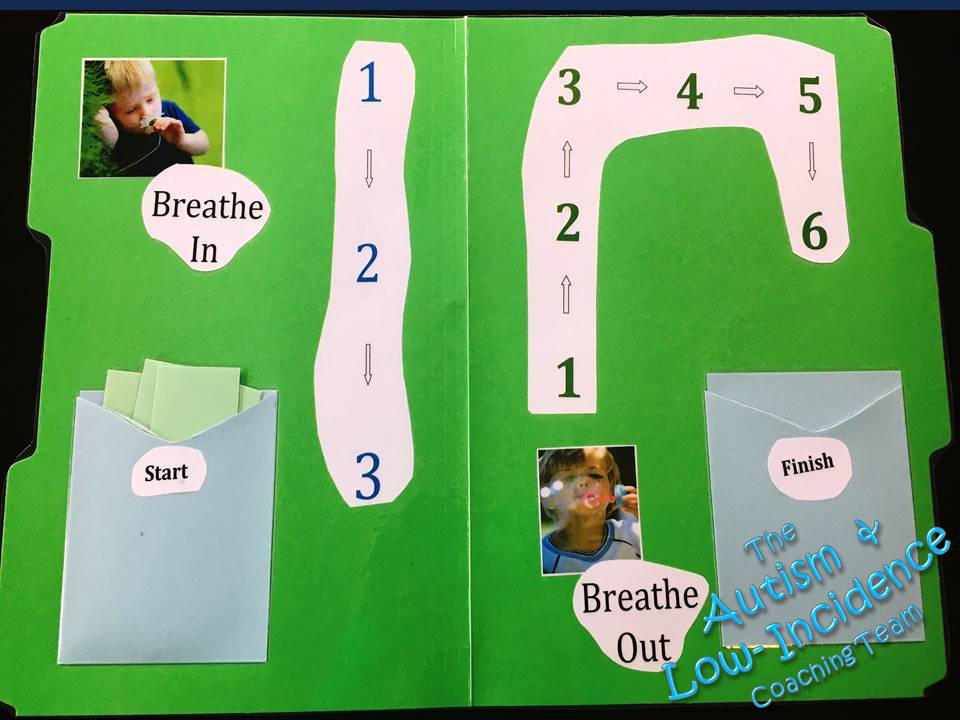
Breathe Folder

Breath Repetition Counting Visual

Rainbow Breath Visual
Heather Balkcom
Springcreek Primary, Piqua


Individual Pull-out Breaks: Some students may need to be pulled out for direct instruction of deep breathing. Or they may benefit from whole body deep breathing activities such as belly breathing or air walk breathing. 
Air Walk Breathing


Sensory Neutral Calming Breaks

At times, students just need a time to relax. They need a break from sensory stimuli and active demands.

Class-wide Breaks: Class-wide breaks can be as simple as turning off the lights and putting on some calming music and allowing students to sit quietly. These breaks can also be a great opportunity to introduce mindfulness and meditation practices. 
GoNoodle FLOW Channel


Calm Connect (formerly MeMoves)
Leslie Mann
Smith Middle School, Vandali Butler

Class Calming Time with Fidgets, Adaptive Seating, and Oceanscape
Rylie Jarrett
Stevenson Elementary, Mad River


Individual Breaks Within Classroom: Having a safe spot to relax within the classroom such as a Calming Corner or Home Base can be a great way for students to escape sensory demands with minimal disruption to their learning. Schedule times to take a calming break before stressful transitions or prior to more challenging academic work. A cozy spot works well for many students while a tent can be an additional barrier to blocking out external clutter and stimuli. 
 
Chill Corner
Barbara Martin
Watts Middle School, Centerville

Calming Corner
Jessica Stewart
Trotwood ELC, Trotwood

Pop Up Tent
Rylie Jarrett
Stevenson Elementary, Mad River


Individual Pull-out Breaks: Some students may need to completely escape the classroom to decompress and regulate. Providing a separate sensory neutral location can be a great support.

Calming Sensory Room
Kettering High School, Kettering

Calming Sensory Room
Demmitt Elementary, Vandalia


When evaluating the effectiveness of your students' sensory break, keep in mind that participation in sensory breaks should result in students feeling/appearing calmer and more regulated. If you need help planning for these important breaks, consult with your district occupational therapist. For more information on proactively scheduled sensory breaks check out our previous blog post:


And for additional information on different types of breaks including Reinforcement and "In the Moment" Breaks don't miss this post:

Tuesday, March 17, 2020

Executive Functioning Forum: Perseverance


Perseverance is required for an individual the follow through on a given task especially when experiencing difficulty or distractions. It may be referred to as goal-directed persistence or having a growth mindset and it is an essential executive functioning skill especially as students get older and face increased challenges. Today’s Executive Functioning Forum will provide tips and examples for teaching Perseverance.


Introduce the Concept of Perseverance
Talk to students about perseverance and identify situations where it is important to persevere. Include both academic and social examples such as writing a research report, completing a science fair project, participating on a sports team, advancing through a long video game, or mastering a difficult musical piece. Encourage students to share personal examples of times when they persevered to complete a difficult task. Help students to see the real-world application of perseverance through making connections to personal experiences or examples from books and movies.


Teach Goal Setting and Planning
In order to persevere, you need to know what the end goal will be. Directly teach goal setting. Start will small, manageable goals (such as completing an assignment) and build up to broader, long-term goals. Provide visual tools to help students set goals and develop a plan towards achieving the goal.

Homework Agenda

Success Ladder Project Planning
Colleen Williams
From the Inside Out
Novel Pacing Guide
PERSIST Strategy
ADHD Journey

Provide Scaffolding and Reinforcement
First start with tasks you know the student will be motivated to persevere through. Build upon their strengths and what they can do well. This will build confidence and positive momentum towards achieving goals and working towards more difficult tasks. Scaffold the amount of assistance you provide so that the student is able to succeed and slowly fade support when the student begins to demonstrate competency.
·       
Special Interest Writing Prompt
Lori Bicknell
Mound Elementary, Miamisburg

Pokemon Progress Monitoring
Ice Cream Progress Monitoring
Bobbi Jo Chapman
Snyder Park Elementary, Springfield

Differentiated Goal Progress Monitoring
Stephanie Foreman
South Vienna Elementary, Northeastern


Incorporate Perseverance into Daily Life
Perseverance should be incorporated into the daily classroom culture. Encourage a growth mindset and frequently use associated vocabulary. Develop reinforcement systems that require students to accumulate “points” or tokens to earn a desired reward. Provide rationales so students understand the end goal and real-word connection. Develop portfolios for student work so they can see all the growth they make over the school year.

 
Classroom Mission Statement
Annette Stine
Kyle Elementary, Troy
Classroom Token Economy
Allysson Rudnicki
Tipp High School, Tipp City


·      
Teach Coping Strategies
Teach students what to do when things don’t go as planned. Give time to practice calming strategies for when they need a break in the moment before trying again.

Mistake Options Visual
Lindsay Carter
Kleptz ELC, Northmont

Calming Sequence
Rachel Hatton
Normandy Elementary, Centerville


Teach Pre-Requisite Executive Functioning Skills
When a student is able to persevere towards an end goal, it also requires them to be able to plan, prioritize, initiate, and sustain attention throughout the task. These are all separate executive functioning skills which may require direct instruction and practice. For ideas check out our previous posts:


Tuesday, February 18, 2020

Executive Functioning Forum: Metacognition


Metacognition is the combination of various executive functioning skills in order to think about one’s own thinking. It helps students check in on one’s own actions during, or shortly after finishing, a task or activity to assure appropriate goal attainment. For instance, metacognition helps a student realize when they have read and understood a text or if they need to reread something again for better comprehension. This seems pretty straightforward but it is actually the combination of being able to hold information in their working memory, control impulses and block out distractions, along with applying phonics and reading skills.

Today’s Executive Functioning Forum will provide some practical strategies for promoting metacognition with students when looking at behavior, social skills, and academics.


Behavior
Build metacognition with your students by helping them make decisions using visual supports such as contingency maps. Throughout the day, students can monitor their own behavior using self-monitoring tools which helps them think about their decisions and behaviors. For some students, debriefing about behavior can be a meaningful way for them to think about a situation that occurred. But be careful with debriefing because it can lead to re-escalating behaviors, anxiety, or defensiveness with some students especially when implemented too soon after an incident. 

Behavior Contingency Map
Taylor Ruef
Stevenson Elementary, Mad River

Choice Road
Katie Sullivan
Valley Forge Elementary, Huber Heights

PAX/Spleem Self-Monitoring
Jen Everett
Springcreek Primary, Piqua
Behavior Reflection Sheet
Korie Jacobs
Mad River Middle School, Mad River

Think It Over Behavior Reflection
Transition Priming
Leslie Mann
Demmitt Elementary, Vandalia

Think Sheet Behavior Reflection
Leslie Mann
Demmitt Elementary, Vandalia

Think Sheet Behavior Reflection
Springcreek Primary

 
Social Skills
When it comes to social skills, students need to learn not only to think about their own thinking (metacognition) but also the thinking of others (social thinking). Social thinking requires direct instruction of specific skills. Once these skills have been directly taught and practiced, incorporate visual tools to help prime and prompt students to remember the strategies that have been taught. Incorporate ways for the student to self-monitor their progress with applying their new social skills to help with generalization and reflection on their own skills. 

Expected/Unexpected Lesson Visuals
Annette Baker
Miami East Elementary, Miami East
 
Thought Bubble Priming Tool
Nancy Cera
Brookville Elementary, Brookville
Expected/Unexpected Visual Supports
Nancy Cera
Brookville Elementary, Brookville

Metacognition Prompts
Leslie Mann
Smith Middle School, Vandalia

Pokemon Social Skill Self-Monitoring


Academics
Metacognition can be incorporated at the beginning, middle, and end of academic lessons. At the start of a lesson, activate prior knowledge, set a purpose for the lesson, and encourage students to make predictions. Embed monitoring questions throughout lessons such as “How did you solve that problem?” or “What can you do to help remember this information?” to help students think about their thinking during the lesson. Directly teach error monitoring skills (i.e. checklists, proofreading, rubrics) and give students the opportunity to practice checking their own work. 

K-W-L Chart

SWAG sentence checklist
Kristen Gregory
Northmoor Elementary, Northmont

For more information on tips and strategies for teaching executive functioning skills visit our previous Executive Functioning Forum Posts: