Showing posts sorted by date for query Core Words. Sort by relevance Show all posts

Monday, May 5, 2025

A-LIST Induction 2025

Our team is thrilled to introduce one of our largest groups of new inductees into our Autism & Low-Incidence Coaching Team’s “A-LIST”. Our A-LIST stands for Autism-Low Incidence Support Team and is comprised of a regional network of select professionals who exhibit “best practices” in serving the needs of students who have autism or other complex, low-incidence disabilities. Our A-LIST began in 2012 in an effort to recognize outstanding individuals who had exceeded the high expectations of our coaching process, and who represented the best that our region had to offer to students with disabilities. Only a fraction of the educators we coach each year are nominated. The A-LIST truly represents the BEST professionals in our region.


The goal of the MCESC Autism & Low-Incidence Coaching Team is to build the capacity of our region’s administrators, teachers, intervention specialists, related service providers, and paraprofessionals to serve children with autism and other complex disabilities. The A-LIST serves a critical role in that mission by maintaining a multi-disciplinary network of outstanding practitioners across all 6 counties we serve. We often refer our coaching teams to our A-LIST members for practical, “in the trenches” perspectives, advice, and occasional modeling of best practices.

In today's A-LIST Spotlight we will be highlighting all EIGHTEEN wonderful new inductees!


Haley Embry


Hayley Embry is an intervention specialist working at the Milton Union Middle School through the Miami County ESC. Hayley was nominated because her classroom is full of evidence-based practices! On top of that, she is the queen of data collection and does such a great job of progress monitoring! What we admire most is Hayley’s ability to collaborate with her staff and the families you serve. She is always actively problem-solving and open to trying new ideas. Hayley clearly takes pride in supporting students in an individualized way, ensuring that their needs are being met. This is especially true with transition supports. Hayley does a great job of providing information and exploration of community-based supports for students and their families. Your leadership style and approach to teaching should be celebrated and deserves to be recognized!


Erin Lukas

Erin Lukas is the intervention specialist in a resource room at Smith Intermediate School in Vandalia. We were impressed with Erin’s ability to recognize the needs of some of her more challenging students and her flexibility in changing how she structured her classroom. She is implementing evidence-based strategies to support her students and has been a model for other teams we are coaching.


Callie George

Callie George is the Speech Pathologist at East Elementary in Eaton. Over the years, we have been impressed with Callie’s ability to collaborate with teachers to support student needs in the classroom. This year, she amazed us with her development of communication lessons that focused on teaching core words in fun and engaging activities. We invited Callie to present with us at the national OCALICON conference in November alongside her teammate and fellow A-LISTer Deanna Hicks.


Rachael Anderson


Rachael Anderson is an outstanding paraprofessional in fellow A-LISTer Taylor Ruef’s classroom at Stevenson Elementary in Mad River. During our numerous A-LIST visits to their classroom, we have been so impressed with how Rachael demonstrates exceptional initiative, consistently stays ahead of student needs, and steps in wherever help is needed to ensure everything runs smoothly. She is an excellent model to others who have visited their classroom, and one of the most frequent and enthusiastic pieces of feedback we receive from visiting teams is about her remarkable ability to support both the students and the classroom environment so seamlessly.


Heather Venters & Linda Daniels

Heather Venters is an Occupational Therapist and Linda Daniels is an Physical Therapist from Montgomery County ESC serving students at Trotwood-Madison Early Learning Center. They are true team players who collaborate seamlessly with every team they are a part of. Heather’s use of structured work during treatment sessions is thoughtful and intentional, and it clearly supports student success. Linda’s treatment sessions are not only functional but also highly motivating for her students. She works closely with classroom staff to ensure that the skills and positioning strategies carry over into the classroom, creating consistency and maximizing student success. Heather and Linda have both been outstanding partners to our team—consistently communicating openly, attending meetings, delivering personalized tools, and modeling the implementation of the strategies and supports we’ve recommended.


Karen Lash

Karen Lash is a paraprofessional at Driscoll Elementary School in the Centerville City School District. Karen demonstrates an intuition with her students that is hard to "teach" because she just "knows" how to respond and meet their needs. Karen is a good "co-regulator" for the students she supports. She has a calm presence and always does a great job of interacting with the students she is working with in a supportive, nurturing way. She also knows when to provide boundaries and limits when those are needed as well. Karen is a team player and always willing to provide feedback or ask questions in team meetings. She also does a great job of managing *all* of the supports needed in the classrooms you have supported through the years. Karen is truly an invaluable member of the Driscoll MD team!


Morgan Brown, Joy Chenault, & Brianna Foster

Morgan Brown is a preschool teacher at Trotwood Early Learning Center and works beside paraprofessionals Joy Chenault and Brianna Foster. They work together seamlessly, truly exemplifying what it means to be a cohesive and effective team. They have created a truly positive and inclusive environment where all students can thrive. The structure and routine they’ve built has clearly boosted student engagement. The team is always fully engaged—modeling expectations, asking thoughtful questions during small groups, offering meaningful praise, and providing students with the individualized support they need to thrive. They are also wonderful co-regulators—no matter what is happening, they remain calm and centered, providing the steady support students need to de-escalate and re-engage.


Mindy Shelton


Mindy Shelton is an intervention specialist at Medlar View Elementary in Miamisburg. We have been impressed with Mindy’s ability to implement evidence-based strategies to meet the needs of students with significant behavioral challenges. She has remained professional and positive through some very difficult times and demonstrated the use of data collection and clear communication with her staff to support the problem-solving process.


Jessica Sanders

Jessica Sanders is an intervention specialist from Driscoll Elementary School in the Centerville City School District. We love going to Jessica’s self-contained classroom because we know we will see so many evidence-based practices in place! Jessica is always interested in coaching and willing to have support for her classroom. That's always the sign of a great teacher...one who is still willing to learn, collaborate, and try new things! What we admire most is her desire to help the "whole" child and also support their families. She is always actively problem-solving and she strives to meet her students' needs outside of the classroom, too. We love how Jessica provides community-based support and suggestions to her students' families as well. Her leadership style and approach to teaching should be celebrated and deserves to be recognized!


Celeste Ritzert

Mary “Celeste” Ritzert was nominated because she demonstrates an intuition with her students that is hard to "teach" because she just "knows". Celeste is a good "co-regulator" because of her calm presence and supportive, nurturing approach with her students. Celeste does an excellent job of providing wait time and ensuring that her students are regulated before having any other expectations for them. She also does a great job of making sure all students have access to communication and are able to express themselves. Celeste does a great job of managing *all* of the supports needed to help the students she is working with be successful. Celeste is truly an invaluable member of the MCESC Learning Center West team!


Kasey Hancock

Kasey Hancock is the intervention specialist at Harry Russell Elementary in West Carrollton. Over the years, we have been impressed with Kasey’s passion to create a classroom environment that meets the diverse needs of her students. She is organized and creative in the implementation of visual strategies and structured work systems. Kasey communicates well with others to promote effective teamwork. We are happy to have her as part of our A-LIST!


Shelly Cummins


Shelly Cummins is an intervention specialist at Camden Elementary School in the Preble Shawnee Local School District. Shelly was nominated because we love coming to her classroom and seeing so many evidence-based practices in place! She is always actively problem-solving and open to trying new ideas. We have also been impressed with her initiative to support students in an individualized way, ensuring that their needs are being met. Shelly is an excellent model for others, and she’s a good "co-regulator" for the students she supports. She has a calm presence and always does a great job of interacting with her students in a supportive, nurturing way. Shelly does a great job of setting goals for her students and wants to push them to make as much progress as possible. Her approach to teaching should be celebrated and deserves to be recognized!


Rachel Lech


Rachel Lech is a kindergarten teacher at Kleptz Early Learning Center in Northmont Schools. One of the keys to her success has been creating a positive, welcoming environment where ALL students feel valued and supported. Her collaboration with the large team of adults supporting her classroom is truly commendable. She consistently primes students with expectations and materials before each activity, and has engaging, attention-grabbing phrases that are both effective and fun. She provides individualized supports—flexible seating, fidgets, sensory tools, visual aids, and reinforcement—ensuring that every child has what they need to thrive. The structured and supportive environment she’s built is clearly contributing to her students’ success.


Aubrey Diane Ludlow


Aubrey Diane Ludlow is the intervention specialist in the Clark Co. ESC self-contained classroom serving students with significant behavior challenges. We were impressed with Aubrey’s insight into the why behind the behaviors and her flexibility in meeting biological and emotional needs to help students be more available for learning. She has created an engaging and warm environment for staff and students. We have already sent a teacher to her classroom to see effective strategies in action.


Jack Stephens

Jack Stephens is the Special Education Supervisor in Mad River Local Schools whose dedication to supporting teachers, advocating for best practices for students, and collaborating with our team is exceptional. Jack does well with guiding his staff toward the very tools and strategies we often recommend which creates a strong foundation of support across his district. Additionally, he has been proactive in his approach to meeting the unique needs of the growing number of students with autism and low-incidence disabilities within the district.

Congratulations to all of our new 2025 A-LIST Inductees! We are excited to have you as an extension of our team!
Tuesday, March 4, 2025

Communication Corner: Why PECS Still Works


Do people still use the Picture Exchange Communication System (PECS)? This was once a popular evidence-based communication intervention but it seems to be a thing of the past. But don’t throw away your PECS manual! There may be a student who still needs this approach. In this post, our Speech and Language Pathologist, Carol Dittoe, will give her feedback on the use of PECS.


As the speech pathologist on the Autism and Low Incidence Coaching Team (ACT), Isometimes asked about my thoughts on the use of PECS.  I want to be clear that PECS is a specific and trademarked system that follows a very detailed protocol that requires training from a Pyramid Educational Consultant. I have been through the formal training but I have also adapted it when needed (so I can no longer officially call it PECS). For more information visit the official PECS website  In today's Communication Corner, I will provide my thoughts about the use of PECS which are based on many years of experience and observations.


  • PECS is more than just using Pictures. PECS is the use of picture EXCHANGE. The E in PECS means exchange. Sometimes when you start with an AAC device, especially a dynamic device, the student focuses on the technology only and does not acknowledge the communication partner.  If the learner is able to see and manipulate a picture, they can develop joint attention by exchanging the picture with a partner to gain the desired item. If they love technology, use picture exchange to request the iPad. 


  • PECS is not always my first option for Augmentative and Alternative Communication (AAC). It is not a prerequisite of AAC. It depends on the needs of the learner. If the learner has good joint attention and is already showing some use of pictures to communicate, I will move on to an AAC device or a static picture-supported communication system that is much more robust.  If the learner does not demonstrate joint attention and does not engage with pictures for communication, PECS is a great way to teach these foundational skills.


  • The first phase of PECS is to teach the initiation of a picture exchange. I love the focus on initiation and feel it is important to avoid developing prompt dependency. You are not supposed to use any verbal prompting. You are to entice the learner rather than prompt them. The use of a second person acting as the physical prompter during Phase 1 is not the same as facilitated communication (if you are doing it correctly). Some people have expressed concern that having a physical prompter is taking away the learner’s autonomy. In my experience with PECS, I am following the lead of the learner by watching for their initiated reach and using physical prompting to shape the reach for an item down to the picture to facilitate the picture exchange. Typically, I only need to use physical prompting for the first few requests before the learner understands how to give the picture to the communication partner to obtain the desired item. The goal is to fade any prompting as quickly as possible.


  • Typically, when using PECS, I focus on the first 3 phases to focus on the development of joint attention, initiation, persistence, and picture discrimination. Here are the first 3 phases of PECS:

  1. Teaching the exchange with a single picture

  2. Teaching the exchange with a single picture, adding distance, and generalizing the skill across people and environments

  3. Teaching picture discrimination between 2 or more pictures (I spend a lot of time at this phase to continue generalizing across settings and people for a variety of items)


  • The strategies in these first 3 phases will make sure the learner takes the responsibility of exchanging the request with the right communication partner. Have you seen a student using a device and repeatedly hitting the button without getting the attention of anyone? It’s almost as if they think it is a magical button that will get them what they want (who needs people?) Even if a team is not using PECS, I may refer them to some of the strategies from PECS to teach initiation, joint attention, and traveling. Traveling is when the learner must travel to get the picture and then travel to give the picture to the right person. This is an important skill weather your student is using pictures or a device. You want to make sure the student is exchanging information with a partner and not just interacting with a device.


Nancy Cera
Brookville Elementary, Brookville


  • When teams are struggling to teach picture discrimination, I often refer them to the PECS manual Phase 3 for some great ideas for teaching, assessing, and reinforcing picture discrimination. Picture discrimination is critical if you plan to use any kind of picture-supported communication. 


Amy D'amico
Learning Center North, MCESC

Watts Middle School, Centerville

  • Phase 4 of PECS is sentence structure. This is where you add the “I want__”. Once I have developed strong joint attention and the learner can discriminate between many pictures across environments, I may start to transition to other more robust systems and introduce core words. 


Sara Moore
Bell Creek Intermediate, Bellbrook


  • While I am a big fan of teaching core words, some students need to start with more concrete language using highly motivating nouns for exchange. The first 3 phases of PECS will focus on the use of highly preferred items. These nouns are considered fringe words (ball, chip, iPad) and are used in a very concrete way to teach the power of pictures for communication. Core words are introduced in phases 4-6 and can be more abstract but are used more frequently in our language and can be combined to have many different meanings. (I, want, see). Descriptive words are also introduced in Phase 4. 


  • If you believe your student needs more of a Gestalt language approach, you can use the strategies of PECS to teach the foundational skills (exchange, initiation, traveling, discrimination) while introducing core words. I like the use of Aided Language Stimulation, a strategy that focuses on the frequent modeling of words on a core board without expecting the learner to respond. This can be done on a static core board or an AAC device. This combination goes against the PECS protocol but if you are not formally using PECS, you can still use many of the PECS strategies to meet the needs of your student. 


Remember, any approach you take to developing functional communication must meet the specific and unique needs of the learner. Get to know your student and ask yourself the following questions to determine if your student would benefit from the strategies of PECS:

  • Do they struggle with joint attention and initiation?

  • Are they highly distracted by technology only focusing on the device and not the partner? 

  • Are they destructive by often throwing or pounding on a device? 

  • Are they unable to use pictures in a meaningful way or discriminate between pictures?

  • Do they rely on others to initiate the use of the device and travel with the device to get the message to the right person?


There are so many factors to consider when choosing the communication mode and strategies to try. Collaboration between the classroom team, SLP, family, and outside therapy is needed. The most important thing is that you try something! You can visit these resources to get more information and assistance when assessing your student’s communication and AAC needs:


PECS is an evidence-based practice. Here is a link to ASHA’s AAC Evidence Map and PECS Evidence-Based Practice Review


Tuesday, December 3, 2024

Best Blog Posts for Communication

To start this school year, our team is compiling some of our best examples of supports we have seen in our districts and featured in previous blog posts. Today we are highlighting all of the Best Blog Posts for Communication. 


Click on the hyperlink under each heading below to be taken to the related post on that topic.


Tuesday, February 13, 2024

Academic Area: Predictable Chart Writing

Comprehensive Literacy Instruction is essential in today's classrooms, including self-contained classrooms and cross-categorical resource rooms. In many cases, reading and writing instruction has fallen by the wayside for our most complex learners however the push toward implementing the Science of Reading in all classrooms emphasizes the need for a shift. 

Shared Writing is one component of Comprehensive Literacy Instruction and a highly effective strategy for engaging students with complex needs in shared writing instruction is Predictable Chart Writing (PCW). PCW provides predictability, offers seamless integration of communication, and can be utilized as an activity for the entire classroom, small groups, or even individual sessions. Today's Academic Area post will break down the 5 steps to the Predictable Chart Writing routine. We want to extend a special thank you to Cynthia Resch at MCESC Learning Center-West for welcoming us into her classroom to model each step of the PCW routine for us to share!


Each step in the Predictable Chart Writing Routine takes place during a new session. Typically, this is done during daily writing instruction over the course of a school week. 


Step 1: Write the Chart (Monday)
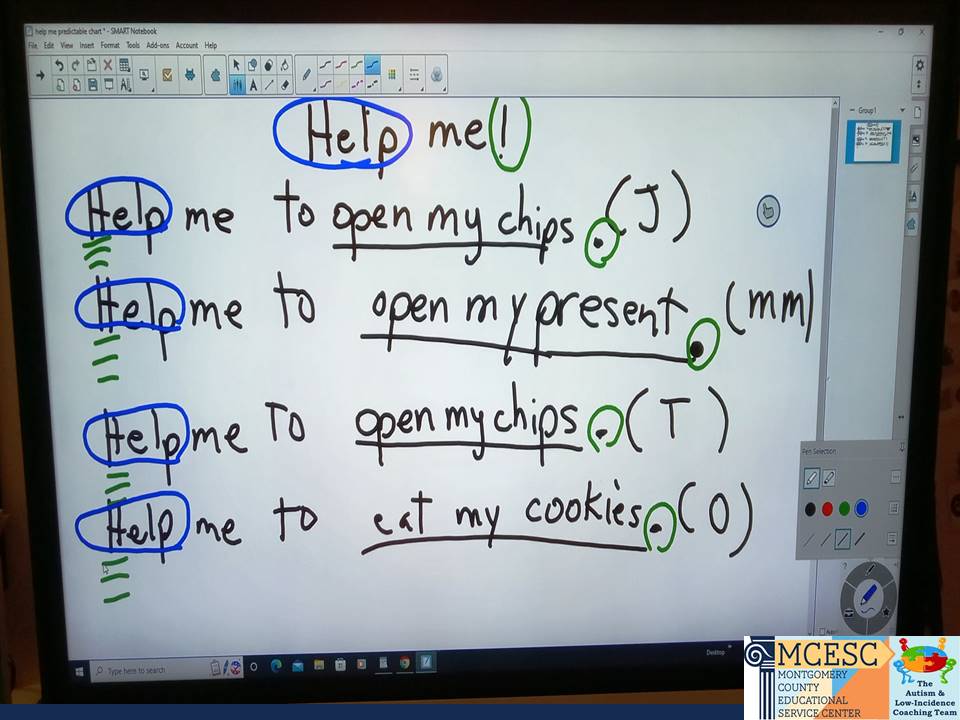
  • Choose a sentence stem. Possible topics could include the current classroom theme, responding to a recent reading passage, or incorporating the use of core words. 
  • The students provide a personalized response to the sentence stem. 
  • Then, the teacher scribes the response on the chart while saying each part aloud.


  • Finally, the group will choral read each sentence when done. 
    • For non-speaking students, utilize AAC such as a big mack switch, communication board, or communication device to facilitate participation. See the example video below: 


Step 2: Reread the Chart (Tuesday)
  • First, the group will reread the entire chart chorally as the teacher points to each word.

  • Then, provide opportunities for individual students to find words such as a targeted core word or content vocabulary. 
  • Next, focus on a specific element (letter, word, convention) when done.
  • Finally, reread a final time.


Step 3: Work with Sentence Strips (Wednesday)
  • First, the group will reread the entire chart chorally as the teacher points to each word.
  • Next, pass out each student’s contribution to them on sentence strips. 
    • You can either prepare these sentence strips ahead of time or use this activity as an opportunity to model.
  • Then, demonstrate how to cut the sentence apart into words (after each cut, reread) and reorder.
  • Eventually, start reordering incorrectly to help students see if the sentence makes sense.
    • Allow students to make mistakes! These are opportunities to recheck work/check for what makes sense
  • After developing an understanding, students will cut apart their own sentences.


Step 4: Be the Sentence (Thursday)
  • First, the group will reread the entire chart chorally as the teacher points to each word.
  • Then, choose a sentence.
  • Next, write on a sentence strip, and then cut it apart.
    • You can either prepare these sentence strips ahead of time or use this activity as an opportunity to model.
  • Then, give each student a word from the sentence and have them physically arrange themselves to reorder the sentence
    • Repeat for 3-4 sentences.
  • Finally, end with a final choral reading of sentences.


Step 5: Make and Publish the Book (Friday)
  • First, the group will reread the entire chart chorally as the teacher points to each word.
  • Then, pass out individual sentences typed/written for book.
    • You can either prepare these sentence strips ahead of time or use this activity as an opportunity to model.
  • Next, students cut apart their sentences and reorder. 
    • Staff will guide students to self-edit by referring to the chart.
  • Then, they will glue their ordered sentence onto their paper. 

  • Next, students will add illustrations
    • They can use their own drawings or find pictures on Google images.
  • Finally, add the finished class book to classroom library.
    • You can also publish the class book to Tarheel Reader or Bookcreator.com for independent reading with technology or at home. 


To see Predictable Chart Writing in action with a group of learners at a variety of instructional levels, check out this video: 


For additional information on implementing Predictable Chart Writing in your classroom, we encourage you to check out these wonderful resources:

Online Modules
Books
Websites