Showing posts sorted by relevance for query Core Words. Sort by date Show all posts

Tuesday, November 5, 2019

Communication Corner- Core Words


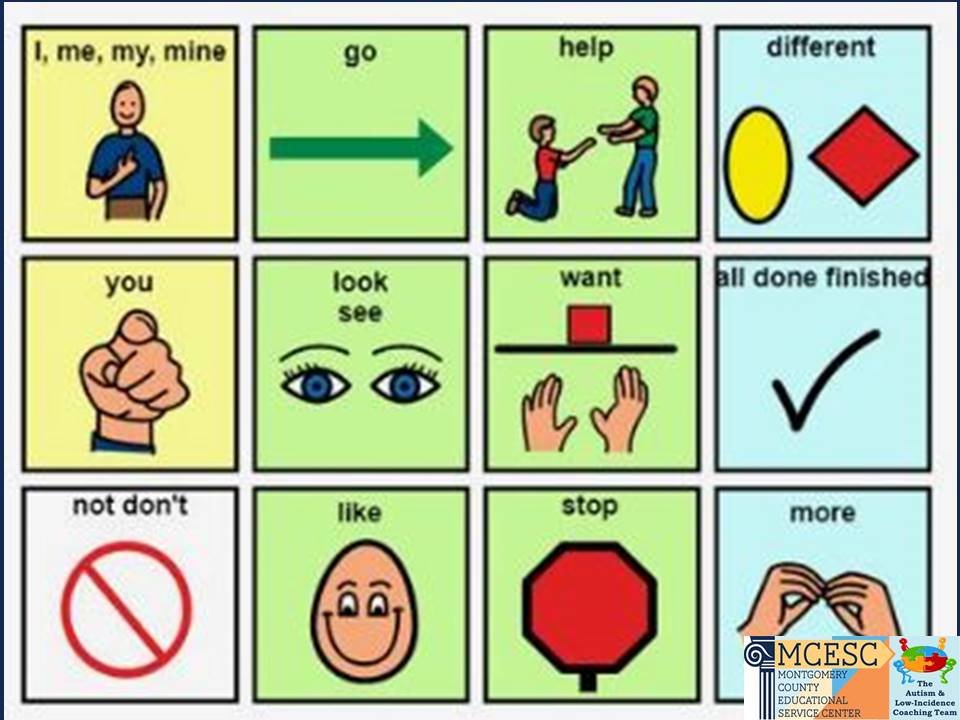
When teaching a student how to communicate, it is often difficult to know where to start. Core words are a great place to start because they are often words that hold a lot of meaning and they are used frequently across the day.  Core words include words such as:

  • Protest words: no, stop, done
  • Attention seeking words: look, help, hi
  • Requesting words: want, more, go
  • Location words: up/down, on/off, in/out
  • Pronouns: I, you, me, it
  • Descriptive words: good/bad, big/little, fast/slow

These are words that can be used in many different situations to meet important communication functions. Core words can be expressed with verbal language, sign language, pictures and communication devices. Most dynamic communication devices have a grid of core words as the home page to make it easy to access the most frequently used core words.

Fringe Words vs Core Words
If we talk about core words, we have to talk about fringe words.  Fringe words are typically nouns. They are very specific to the situation and may not be used repeatedly across the day. Fringe words are more concrete and easily represented by a picture, while core words can be more difficult to represent with a picture. If you are training a student to use Picture Exchange Communication System (PECS), you will start by teaching fringe words. This is because when teaching an exchange, it is easier to exchange a picture for an object. When teaching fringe words it is best to start with words that are highly motivating for the student. Pair core words with fringe words to expand communication.  On more advanced communication devices, core words are often the home page and the user must navigate to find the fringe words. This is because there are many more fringe words than core words.

Teach use of core words across the day
Repeated practice is essential to developing functional use of language. We love how our ALIST speech and language pathologist Ann-Marie Small provides direct instruction of core words to her students through a variety of engaging activities. 

First students read a Core Word Vocabulary Book which provides many repetitions of the targeted word. These books can be found here: AdaptEd for Special Ed Core Vocabulary Books TPT

Ann-Marie Small
Driscoll Elementary, Centerville

Then, Ann-Marie provides practical practice through fun activities. For the core word "find" students played a game of elf hide and seek. They had many opportunities to talk about how they had to "find" the elf! 

Ann-Marie Small
Driscoll Elementary, Centerville

Ann-Marie Small
Driscoll Elementary, Centerville

Books from previous lessons are incorporated into the library so students can practice them over and over. 
Ann-Marie Small
Driscoll Elementary, Centerville


Ann-Marie collaborates with her teachers so that the core word instruction is incorporated into the classroom. There are visual reminders provided to staff as well as posted on the classroom doors so that any visitors can help to facilitate the core words.

Ann-Marie Small
Driscoll Elementary, Centerville


Consider how target core words can be modeled and facilitated across the day. Look at the student’s schedule and make a plan to incorporate use of the target core words. Many of our teams do a “core word of the week” to encourage all staff to practice the use of a target word. They use these great visuals from Speech Room News. The visuals can be passed out to staff members and/or posted around the classroom to provide reminders for staff. These visual reminders can be found here: Speech Room News Core Word of the Week TPT


Rachel Engle and Rebecca Spidel
Horace Mann Elementary, Springfield


Rachel Engle and Rebecca Spidel
Horace Mann Elementary, Springfield

Laurie Maravetz and Mitch Duncan
Schaefer Middle School, Springfield


In addition to modeling use of the core word, it will be important to expect the learner to initiate use of the word for communication. Instead of prompting, entice the use of the word and wait. As soon as the core word is communicated, respond in a meaningful way to reinforce the learner. The goal is to develop functional and spontaneous use of powerful core words.

Once the students start to develop a repertoire of core words, many of our teams have posted PECS cards and designated core word boards in the classroom for easy access to the vocabulary throughout the day. 

Mitch Duncan
Springfield High School, Springfield

Casey Lathrop and Katie Bigelow
Brookville Elementary, Brookville

Allison Clements
Schnell Elementary, West Carrollton

Susie Stoner and Heather Costa
Bradford Elementary, Bradford

Tuesday, December 19, 2023

Communication Corner: Modeling and Facilitating Core Words Across the Day

Teaching core words is an important step in developing functional communication. When we go out into districts we see so many ways to model and facilitate the use of core words in natural ways. The adults should model the use of core words all the time in order for students to learn functional use of the words. 


In today's Communication Corner we will highlight ideas for Modeling and Facilitating Core Words Across the Day. 


Provide access to core words in the classroom with core word boards posted on the walls in key locations of the room.

Laura Windholtz
Learning Center West, MCESC


Lisa Turner
Mad River ECC, Mad River

Carla Bryant
Miamisburg

Maddie Boyd
Park Layne Elementary, Tecumseh


Directly teach new words and provide ample opportunities for practice. 

Heather Clark
Saville Elementary, Mad River

Ann-Marie Small
Driscoll Elementary, Centerville


Provide access to core words on the go!

Laura Windholtz
Learning Center West, MCESC


 Provide access to core words on the playground.


Jessica Wright
Smith Elementary, Oakwood

Jessica Wright
Smith Elementary, Oakwood

If a student is going to be using a communication device but does not always have access to it,  print and laminate a copy of the core home page to provide easy access in the classroom and on the go. You can take a picture of the home page or find it online. This way the student can practice using the same pictures in the same locations as they will on their device.


Post reminders for the staff to model and facilitate target words.


Laura Windholtz
Learning Center West, MCESC

Laura Windholtz
Learning Center West, MCESC


Laura Windholtz
Learning Center West, MCESC


Taylor Ruef
Stevenson Elementary, Mad River

Ann-Marie Small
Driscoll Elementary, Centerville


If you need to expand the core board or add fringe words, consider creating a flipbook.


Carla Bryant
Miamisburg

Carla Bryant
Miamisburg


You can also add fringe words by posting choice boards in key locations of the room.


Michelle Wade
Northridge Elementary, Northridge


If you have a static display voice output device such as a Go Talk or Tech Speak you can create a core page and have a section where you can insert different fringe words as needed. This way the core words are always in the same location. This Tech Speak overlay was created to practice core words during fun interactive activities such as playing with blocks or blowing up and letting go of a balloon.


How do you model and practice functional use of core words in your classroom? Visit our Communication Corner blog on Core Words for more ideas! 

Communication Corner: Core Words

Tuesday, November 19, 2019

ALIST Spotlight- Amy D'Amico MCESC Learning Center West

Earlier this month we discussed Core Words and how they can be a great place to start when facilitating the use of language in the classroom. So we thought this would be the perfect time to shine our ALIST Spotlight on Amy D'Amico at Montgomery County ESC Learning Center West who loves to use core words with her students.


Amy shares "I have known about core vocabulary for years but I have been unsure how to implement the strategy with my students because of the nature of my caseload. Most of my students have AAC systems but often there are multiple types of AAC systems with different symbol sets in one classroom and often I have students at various levels of language development in a single classroom. This is quite challenging and overwhelming. Focusing on core vocabulary has helped simplify how I provide speech services. I now focus more on teaching language and language function than teaching how to locate fringe vocabulary on all the different devices. It has also improved self-advocacy because if I can teach them to say "Stop", "Go away", "I like that" or "I don't want that", they will have more control over their lives.

Here are some great pictures of Amy in action using core word supports with her students:


Keep up the great work, Amy! Your students are lucky to have you and it is great to see how you are helping them to develop their functional communication using core words!


For more information on using core words in the classroom, check out our previous post:

Tuesday, March 4, 2025

Communication Corner: Why PECS Still Works


Do people still use the Picture Exchange Communication System (PECS)? This was once a popular evidence-based communication intervention but it seems to be a thing of the past. But don’t throw away your PECS manual! There may be a student who still needs this approach. In this post, our Speech and Language Pathologist, Carol Dittoe, will give her feedback on the use of PECS.


As the speech pathologist on the Autism and Low Incidence Coaching Team (ACT), Isometimes asked about my thoughts on the use of PECS.  I want to be clear that PECS is a specific and trademarked system that follows a very detailed protocol that requires training from a Pyramid Educational Consultant. I have been through the formal training but I have also adapted it when needed (so I can no longer officially call it PECS). For more information visit the official PECS website  In today's Communication Corner, I will provide my thoughts about the use of PECS which are based on many years of experience and observations.


  • PECS is more than just using Pictures. PECS is the use of picture EXCHANGE. The E in PECS means exchange. Sometimes when you start with an AAC device, especially a dynamic device, the student focuses on the technology only and does not acknowledge the communication partner.  If the learner is able to see and manipulate a picture, they can develop joint attention by exchanging the picture with a partner to gain the desired item. If they love technology, use picture exchange to request the iPad. 


  • PECS is not always my first option for Augmentative and Alternative Communication (AAC). It is not a prerequisite of AAC. It depends on the needs of the learner. If the learner has good joint attention and is already showing some use of pictures to communicate, I will move on to an AAC device or a static picture-supported communication system that is much more robust.  If the learner does not demonstrate joint attention and does not engage with pictures for communication, PECS is a great way to teach these foundational skills.


  • The first phase of PECS is to teach the initiation of a picture exchange. I love the focus on initiation and feel it is important to avoid developing prompt dependency. You are not supposed to use any verbal prompting. You are to entice the learner rather than prompt them. The use of a second person acting as the physical prompter during Phase 1 is not the same as facilitated communication (if you are doing it correctly). Some people have expressed concern that having a physical prompter is taking away the learner’s autonomy. In my experience with PECS, I am following the lead of the learner by watching for their initiated reach and using physical prompting to shape the reach for an item down to the picture to facilitate the picture exchange. Typically, I only need to use physical prompting for the first few requests before the learner understands how to give the picture to the communication partner to obtain the desired item. The goal is to fade any prompting as quickly as possible.


  • Typically, when using PECS, I focus on the first 3 phases to focus on the development of joint attention, initiation, persistence, and picture discrimination. Here are the first 3 phases of PECS:

  1. Teaching the exchange with a single picture

  2. Teaching the exchange with a single picture, adding distance, and generalizing the skill across people and environments

  3. Teaching picture discrimination between 2 or more pictures (I spend a lot of time at this phase to continue generalizing across settings and people for a variety of items)


  • The strategies in these first 3 phases will make sure the learner takes the responsibility of exchanging the request with the right communication partner. Have you seen a student using a device and repeatedly hitting the button without getting the attention of anyone? It’s almost as if they think it is a magical button that will get them what they want (who needs people?) Even if a team is not using PECS, I may refer them to some of the strategies from PECS to teach initiation, joint attention, and traveling. Traveling is when the learner must travel to get the picture and then travel to give the picture to the right person. This is an important skill weather your student is using pictures or a device. You want to make sure the student is exchanging information with a partner and not just interacting with a device.


Nancy Cera
Brookville Elementary, Brookville


  • When teams are struggling to teach picture discrimination, I often refer them to the PECS manual Phase 3 for some great ideas for teaching, assessing, and reinforcing picture discrimination. Picture discrimination is critical if you plan to use any kind of picture-supported communication. 


Amy D'amico
Learning Center North, MCESC

Watts Middle School, Centerville

  • Phase 4 of PECS is sentence structure. This is where you add the “I want__”. Once I have developed strong joint attention and the learner can discriminate between many pictures across environments, I may start to transition to other more robust systems and introduce core words. 


Sara Moore
Bell Creek Intermediate, Bellbrook


  • While I am a big fan of teaching core words, some students need to start with more concrete language using highly motivating nouns for exchange. The first 3 phases of PECS will focus on the use of highly preferred items. These nouns are considered fringe words (ball, chip, iPad) and are used in a very concrete way to teach the power of pictures for communication. Core words are introduced in phases 4-6 and can be more abstract but are used more frequently in our language and can be combined to have many different meanings. (I, want, see). Descriptive words are also introduced in Phase 4. 


  • If you believe your student needs more of a Gestalt language approach, you can use the strategies of PECS to teach the foundational skills (exchange, initiation, traveling, discrimination) while introducing core words. I like the use of Aided Language Stimulation, a strategy that focuses on the frequent modeling of words on a core board without expecting the learner to respond. This can be done on a static core board or an AAC device. This combination goes against the PECS protocol but if you are not formally using PECS, you can still use many of the PECS strategies to meet the needs of your student. 


Remember, any approach you take to developing functional communication must meet the specific and unique needs of the learner. Get to know your student and ask yourself the following questions to determine if your student would benefit from the strategies of PECS:

  • Do they struggle with joint attention and initiation?

  • Are they highly distracted by technology only focusing on the device and not the partner? 

  • Are they destructive by often throwing or pounding on a device? 

  • Are they unable to use pictures in a meaningful way or discriminate between pictures?

  • Do they rely on others to initiate the use of the device and travel with the device to get the message to the right person?


There are so many factors to consider when choosing the communication mode and strategies to try. Collaboration between the classroom team, SLP, family, and outside therapy is needed. The most important thing is that you try something! You can visit these resources to get more information and assistance when assessing your student’s communication and AAC needs:


PECS is an evidence-based practice. Here is a link to ASHA’s AAC Evidence Map and PECS Evidence-Based Practice Review