
Cartooning is an effective strategy that provides the use of drawings, thought bubbles, and speech bubbles to add visuals when processing social situations with your students. Research shows that cartoon techniques, such as thought and speech bubbles, enable individuals with autism to get a sense of social interactions and the hidden rules that govern behaviors (Kerr & Durkin, 2004). Think about how often you verbally try to process social situations with your students. You try to explain what they did wrong or try to help them understand the intentions of others. It is well known that students with autism or other neurological differences may struggle with auditory information. They need to see it to understand it. They need help making sense of the behaviors of others and all of those unwritten social rules. Cartooning can help. In today's Sensational Social Skills post, ACT team Speech and Language Pathologist Carol Dittoe will provide more information about this great strategy!
Who does Cartooning Benefit?
Cartooning can benefit students who:- can read
- benefit from the use of visuals
- struggle with anxiety and social skills
- do not understand the thoughts, feelings, and intentions of others
- become escalated or shut down when you try to verbally process challenging social situations
How can I use Cartooning with my students?
Cartooning can be used to:- teach conversation skills
- prime for upcoming social situations
- process past social situations and understand the intentions or feelings of others
- engage in social problem solving
What can Cartooning be used to illustrate?
Cartooning can illustrate:- where you are
- who is with you
- what you or others are doing
- what you or others are saying
What types of social skills can be taught using Cartooning?
Cartooning allows you to reflect on:
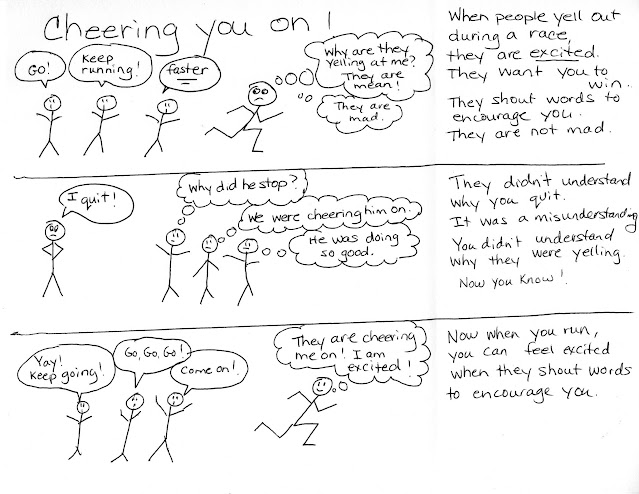
Here is an example of a cartoon created when talking to a student about running in track. The student wanted to quit because he thought his peers were being mean and yelling at him. In reality, they were cheering him on and encouraging him to run faster. Rather than just verbally explaining this to him, a cartoon was used to illustrate the situation. This helped the student understand the intention of his peers, and he felt encouraged to keep running. He was able to take the cartoon home to review with his parents, and it was used to prime him before the next track meet.
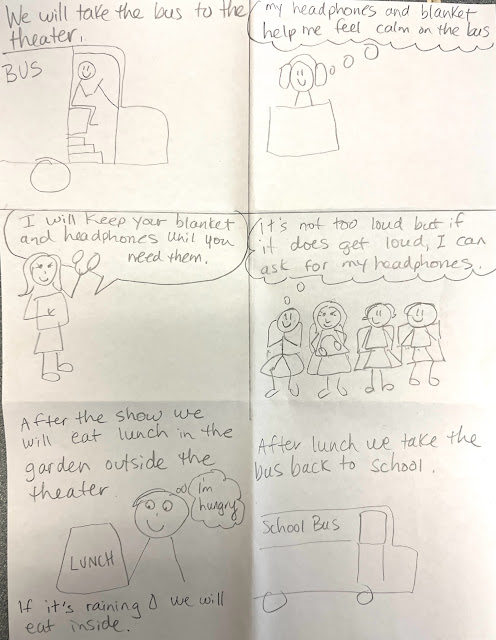
Next is an example of a cartoon that describes the events of an upcoming field trip. Keep in mind that your student may take information very literally. While you want to be clear about what the student can expect, you don’t want to include very specific details that may not be accurate. Instead, use general terms or provide possible variations. Create a cartoon that helps the student feel prepared and aware of the general order of events. When drawing the cartoon and talking to your student, use this time to answer any questions or talk about any concerns the student may have. Reassuring options can be included in the cartoon. The student can take the cartoon home, and you can make a copy to keep at school to review before the field trip.
When using cartooning to teach conversation skills, you can help the student practice greetings, turn-taking, and ending the conversation. Drawing the conversation can be a safe way to plan and practice what to say and how to act. You can include body language and facial expressions in your drawings.
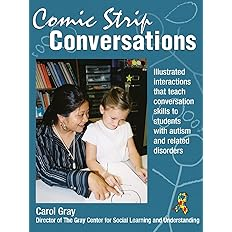
Comic Strip Conversations is a book by Carol Gray that describes how to introduce the strategy of cartooning and provides a Conversation Symbol Dictionary to show conversation behaviors such as:
Interrupting, listening, talking, thinking, volume, and the use of colors to illustrate emotions
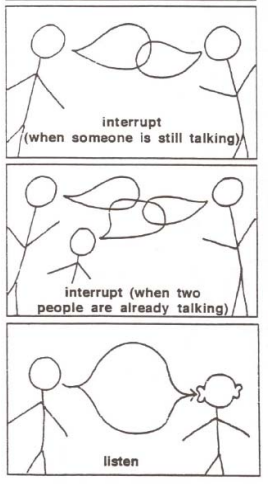
So, if you find yourself needing to explain social situations, intentions, and expectations to your student, consider using the cartooning strategy to provide your student with a visual representation. This can help your student better understand the situation and reduce their frustration. Keep the cartoons for future reference when you prime your student for a similar situation. Remember, your students can do better when they know better!
For more information about Cartooning check out these resources:
- what you/others might be feeling or thinking
- the possible intentions
- identified problems and solutions
- how to do it differently next time
Here is an example of a cartoon created when talking to a student about running in track. The student wanted to quit because he thought his peers were being mean and yelling at him. In reality, they were cheering him on and encouraging him to run faster. Rather than just verbally explaining this to him, a cartoon was used to illustrate the situation. This helped the student understand the intention of his peers, and he felt encouraged to keep running. He was able to take the cartoon home to review with his parents, and it was used to prime him before the next track meet.
Next is an example of a cartoon that describes the events of an upcoming field trip. Keep in mind that your student may take information very literally. While you want to be clear about what the student can expect, you don’t want to include very specific details that may not be accurate. Instead, use general terms or provide possible variations. Create a cartoon that helps the student feel prepared and aware of the general order of events. When drawing the cartoon and talking to your student, use this time to answer any questions or talk about any concerns the student may have. Reassuring options can be included in the cartoon. The student can take the cartoon home, and you can make a copy to keep at school to review before the field trip.
When using cartooning to teach conversation skills, you can help the student practice greetings, turn-taking, and ending the conversation. Drawing the conversation can be a safe way to plan and practice what to say and how to act. You can include body language and facial expressions in your drawings.
Comic Strip Conversations is a book by Carol Gray that describes how to introduce the strategy of cartooning and provides a Conversation Symbol Dictionary to show conversation behaviors such as:
Interrupting, listening, talking, thinking, volume, and the use of colors to illustrate emotions
How to get started with cartooning:
Materials needed:- Use paper and pencil with an eraser. This allows you to make changes or corrections while drawing, and have a finished product you can keep.
- Add pre-drawn boxes to the paper to keep cartoons organized with a sequence of events.
- Consider providing a variety of colored pencils to add emotion to the drawings.
- Drawings can be collected in a folder or binder personalized by the student. These can be referred to later for review or priming.
- A dry-erase board can also be used for quick on-the-go drawings. If you decide you want to keep a drawing, you can take a picture of it before erasing it.
- I like to draw the cartoons in-the-moment. If you or your student prefer to use technology, here are some options:
- First, introduce Cartooning in a non-personal way by drawing cartoons to illustrate social situations from books or movies.
- You can introduce cartooning in a personal way by drawing cartoons that illustrate positive social interactions and small talk. The goal is to teach the basics of cartooning without developing a negative association with the strategy.
- Once the basics of cartooning have been introduced, use this visual strategy when you need to process or plan a social situation and reflect on thoughts and feelings.
- Don’t worry about being good at drawing. This can be a quick in-the-moment strategy using simple stick figures.
- Draw while you are talking to the student so you can illustrate your words and include their input. If your student likes to draw, you can share the drawing process with the student. You can both add to the same drawing, or you can each draw your own perspective of the situation. This will allow you to better understand the student’s perspective.
So, if you find yourself needing to explain social situations, intentions, and expectations to your student, consider using the cartooning strategy to provide your student with a visual representation. This can help your student better understand the situation and reduce their frustration. Keep the cartoons for future reference when you prime your student for a similar situation. Remember, your students can do better when they know better!
For more information about Cartooning check out these resources:

.png)


