Showing posts with label communication corner. Show all posts

Tuesday, March 4, 2025

Communication Corner: Why PECS Still Works


Do people still use the Picture Exchange Communication System (PECS)? This was once a popular evidence-based communication intervention but it seems to be a thing of the past. But don’t throw away your PECS manual! There may be a student who still needs this approach. In this post, our Speech and Language Pathologist, Carol Dittoe, will give her feedback on the use of PECS.


As the speech pathologist on the Autism and Low Incidence Coaching Team (ACT), Isometimes asked about my thoughts on the use of PECS.  I want to be clear that PECS is a specific and trademarked system that follows a very detailed protocol that requires training from a Pyramid Educational Consultant. I have been through the formal training but I have also adapted it when needed (so I can no longer officially call it PECS). For more information visit the official PECS website  In today's Communication Corner, I will provide my thoughts about the use of PECS which are based on many years of experience and observations.


  • PECS is more than just using Pictures. PECS is the use of picture EXCHANGE. The E in PECS means exchange. Sometimes when you start with an AAC device, especially a dynamic device, the student focuses on the technology only and does not acknowledge the communication partner.  If the learner is able to see and manipulate a picture, they can develop joint attention by exchanging the picture with a partner to gain the desired item. If they love technology, use picture exchange to request the iPad. 


  • PECS is not always my first option for Augmentative and Alternative Communication (AAC). It is not a prerequisite of AAC. It depends on the needs of the learner. If the learner has good joint attention and is already showing some use of pictures to communicate, I will move on to an AAC device or a static picture-supported communication system that is much more robust.  If the learner does not demonstrate joint attention and does not engage with pictures for communication, PECS is a great way to teach these foundational skills.


  • The first phase of PECS is to teach the initiation of a picture exchange. I love the focus on initiation and feel it is important to avoid developing prompt dependency. You are not supposed to use any verbal prompting. You are to entice the learner rather than prompt them. The use of a second person acting as the physical prompter during Phase 1 is not the same as facilitated communication (if you are doing it correctly). Some people have expressed concern that having a physical prompter is taking away the learner’s autonomy. In my experience with PECS, I am following the lead of the learner by watching for their initiated reach and using physical prompting to shape the reach for an item down to the picture to facilitate the picture exchange. Typically, I only need to use physical prompting for the first few requests before the learner understands how to give the picture to the communication partner to obtain the desired item. The goal is to fade any prompting as quickly as possible.


  • Typically, when using PECS, I focus on the first 3 phases to focus on the development of joint attention, initiation, persistence, and picture discrimination. Here are the first 3 phases of PECS:

  1. Teaching the exchange with a single picture

  2. Teaching the exchange with a single picture, adding distance, and generalizing the skill across people and environments

  3. Teaching picture discrimination between 2 or more pictures (I spend a lot of time at this phase to continue generalizing across settings and people for a variety of items)


  • The strategies in these first 3 phases will make sure the learner takes the responsibility of exchanging the request with the right communication partner. Have you seen a student using a device and repeatedly hitting the button without getting the attention of anyone? It’s almost as if they think it is a magical button that will get them what they want (who needs people?) Even if a team is not using PECS, I may refer them to some of the strategies from PECS to teach initiation, joint attention, and traveling. Traveling is when the learner must travel to get the picture and then travel to give the picture to the right person. This is an important skill weather your student is using pictures or a device. You want to make sure the student is exchanging information with a partner and not just interacting with a device.


Nancy Cera
Brookville Elementary, Brookville


  • When teams are struggling to teach picture discrimination, I often refer them to the PECS manual Phase 3 for some great ideas for teaching, assessing, and reinforcing picture discrimination. Picture discrimination is critical if you plan to use any kind of picture-supported communication. 


Amy D'amico
Learning Center North, MCESC

Watts Middle School, Centerville

  • Phase 4 of PECS is sentence structure. This is where you add the “I want__”. Once I have developed strong joint attention and the learner can discriminate between many pictures across environments, I may start to transition to other more robust systems and introduce core words. 


Sara Moore
Bell Creek Intermediate, Bellbrook


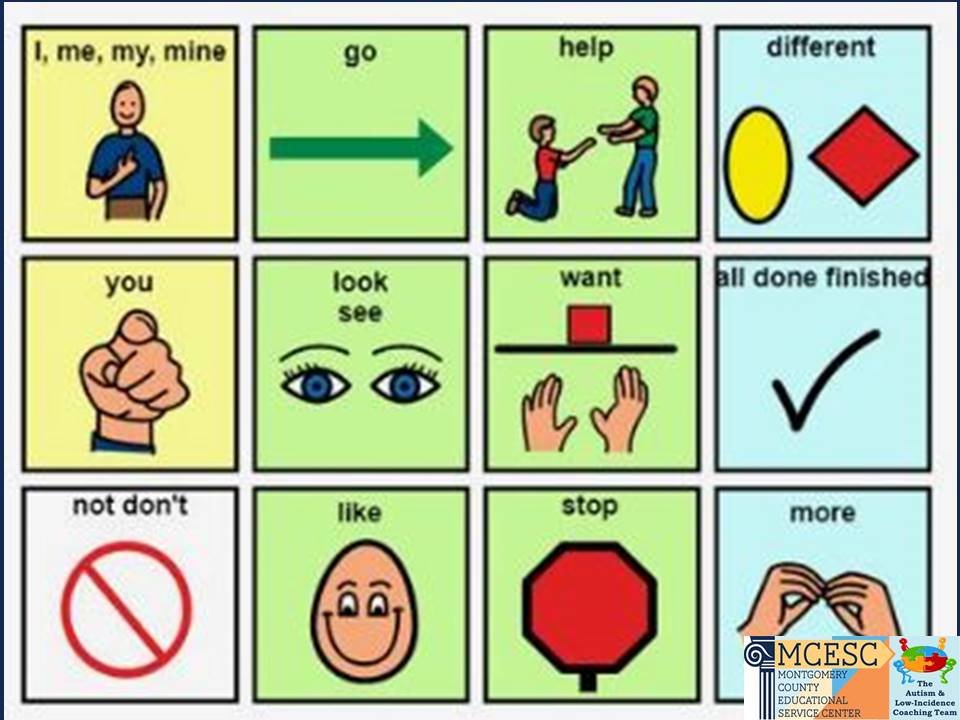
  • While I am a big fan of teaching core words, some students need to start with more concrete language using highly motivating nouns for exchange. The first 3 phases of PECS will focus on the use of highly preferred items. These nouns are considered fringe words (ball, chip, iPad) and are used in a very concrete way to teach the power of pictures for communication. Core words are introduced in phases 4-6 and can be more abstract but are used more frequently in our language and can be combined to have many different meanings. (I, want, see). Descriptive words are also introduced in Phase 4. 


  • If you believe your student needs more of a Gestalt language approach, you can use the strategies of PECS to teach the foundational skills (exchange, initiation, traveling, discrimination) while introducing core words. I like the use of Aided Language Stimulation, a strategy that focuses on the frequent modeling of words on a core board without expecting the learner to respond. This can be done on a static core board or an AAC device. This combination goes against the PECS protocol but if you are not formally using PECS, you can still use many of the PECS strategies to meet the needs of your student. 


Remember, any approach you take to developing functional communication must meet the specific and unique needs of the learner. Get to know your student and ask yourself the following questions to determine if your student would benefit from the strategies of PECS:

  • Do they struggle with joint attention and initiation?

  • Are they highly distracted by technology only focusing on the device and not the partner? 

  • Are they destructive by often throwing or pounding on a device? 

  • Are they unable to use pictures in a meaningful way or discriminate between pictures?

  • Do they rely on others to initiate the use of the device and travel with the device to get the message to the right person?


There are so many factors to consider when choosing the communication mode and strategies to try. Collaboration between the classroom team, SLP, family, and outside therapy is needed. The most important thing is that you try something! You can visit these resources to get more information and assistance when assessing your student’s communication and AAC needs:


PECS is an evidence-based practice. Here is a link to ASHA’s AAC Evidence Map and PECS Evidence-Based Practice Review


Tuesday, December 3, 2024

Best Blog Posts for Communication

To start this school year, our team is compiling some of our best examples of supports we have seen in our districts and featured in previous blog posts. Today we are highlighting all of the Best Blog Posts for Communication. 


Click on the hyperlink under each heading below to be taken to the related post on that topic.


Tuesday, December 19, 2023

Communication Corner: Modeling and Facilitating Core Words Across the Day

Teaching core words is an important step in developing functional communication. When we go out into districts we see so many ways to model and facilitate the use of core words in natural ways. The adults should model the use of core words all the time in order for students to learn functional use of the words. 


In today's Communication Corner we will highlight ideas for Modeling and Facilitating Core Words Across the Day. 


Provide access to core words in the classroom with core word boards posted on the walls in key locations of the room.

Laura Windholtz
Learning Center West, MCESC


Lisa Turner
Mad River ECC, Mad River

Carla Bryant
Miamisburg

Maddie Boyd
Park Layne Elementary, Tecumseh


Directly teach new words and provide ample opportunities for practice. 

Heather Clark
Saville Elementary, Mad River

Ann-Marie Small
Driscoll Elementary, Centerville


Provide access to core words on the go!

Laura Windholtz
Learning Center West, MCESC


 Provide access to core words on the playground.


Jessica Wright
Smith Elementary, Oakwood

Jessica Wright
Smith Elementary, Oakwood

If a student is going to be using a communication device but does not always have access to it,  print and laminate a copy of the core home page to provide easy access in the classroom and on the go. You can take a picture of the home page or find it online. This way the student can practice using the same pictures in the same locations as they will on their device.


Post reminders for the staff to model and facilitate target words.


Laura Windholtz
Learning Center West, MCESC

Laura Windholtz
Learning Center West, MCESC


Laura Windholtz
Learning Center West, MCESC


Taylor Ruef
Stevenson Elementary, Mad River

Ann-Marie Small
Driscoll Elementary, Centerville


If you need to expand the core board or add fringe words, consider creating a flipbook.


Carla Bryant
Miamisburg

Carla Bryant
Miamisburg


You can also add fringe words by posting choice boards in key locations of the room.


Michelle Wade
Northridge Elementary, Northridge


If you have a static display voice output device such as a Go Talk or Tech Speak you can create a core page and have a section where you can insert different fringe words as needed. This way the core words are always in the same location. This Tech Speak overlay was created to practice core words during fun interactive activities such as playing with blocks or blowing up and letting go of a balloon.


How do you model and practice functional use of core words in your classroom? Visit our Communication Corner blog on Core Words for more ideas! 

Communication Corner: Core Words

Tuesday, May 18, 2021

Communication Corner: Encouraging Group Participation

In the classroom, learning often takes place in a small or large group. This can be challenging when you have students who come to your class with very individual needs. Group learning can be very stressful for students who struggle with communication and social demands. Some students struggle to keep their bodies regulated. We all know, in a group setting, when one student is dysregulated the whole group can become dysregulated. In order for each student to participate and engage in learning, it will be important to consider the communication, social, and regulation supports below. Today's Communication Corner will provide some tips and examples for Encouraging Group Participation.


Communication Supports:

Make sure each student has a method to participate. If they use AAC, make sure their device is set up for quick and easy access. A voice output button can allow even the most challenged student a simple method to participate.
GoTalk 9+ AAC for Circle Time
Mandy Whitfield
MCESC-Learning Center East, MCESC


Provide pictures to allow better understanding and quick responses. Even verbal communicators will benefit from the use of pictures and visual supports.

Greene INC, Greene ESC

A Wh-Flipbook is another helpful visual support that can be used during group activities. By providing picture responses, all the students are able to respond to questions and participate in the activity. Remember, visual input is processed much more quickly and efficiently than auditory input. By providing visual supports, you are reducing the anxiety for students who struggle with language processing and expressive communication.


Different students may need different communication tools for the same activity. It is important to differentiate to help these students participate to the best of their ability!
iPad AAC with Proloquo2Go

Picture Choices

Step-By-Step AAC Switch


Social Supports:

Some students are very aware of their peers and become extremely stressed when they know others are watching them and waiting for them to respond. They may avoid participation in fear of being wrong or embarrassed with the way they respond. It is important to set students up for success. Communication supports can also be a helpful way to make sure all students have a quick and easy way to participate in social interactions.
Greeting Choices
Tara Henriksen
Beavertown Preschool, Kettering


You will also want to consider the difficulty of the task. Modify the task demands to allow student success. Students who are shy and withdrawn will need to experience easy success to begin building their confidence. Consider the use of a peer mentor to provide support during group learning. Identify a kind and helpful student who can sit next to a student who is struggling. Teach the peer mentor strategies to be helpful without causing embarrassment or adding more stress.

Students with poor social skills may engage in behavior that is disruptive to the group such as interrupting or making negative comments about the responses of others. Specific social skills will need to be directly taught and practiced in structured lessons outside the group instruction. The student will need to be primed to use those skills just prior to the group activity to facilitate success. You can also work with the whole group to create videos to model expected group behavior by catching students demonstrating target skills. Most kids love to see themselves in the video so they try hard to demonstrate the target skills.

Visit our Sensational Social Skills Blog to get ideas for teaching specific social skills that are important in a group setting:


Regulation and Engagement Supports:

There are many hidden demands associated with being in a group that can make students feel very dysregulated. Students may feel anxious about unexpected touch from students sitting nearby. They may feel overwhelmed about the competing and constantly shifting auditory and visual input of a group. Many students struggle with passive listening and need something to keep their bodies alert and engaged in the lesson. Some students need movement and struggle to sit still. Depending on the activity prior to group, some students may come to the group already dysregulated. Consider the following strategies to keep your group regulated and engaged:

Consider preferential seating. If a student has anxiety about unexpected touch or other sensory sensitivies, allow the student to sit away from the group. Often, we find students can learn from a group session even when sitting outside the group. In fact, they are more available for learning because they are no longer stressed or overwhelmed by the sensory input. If the student seeks movement, consider allowing the student to sit in a different type of chair that provides boundaries while allowing movement. Some students do well when allowed to stand or pace in a defined area. You can use tape on the floor to make clear boundaries for students who need to stand or pace during group instruction.


Student Home Base
Ashley Fry
Bradford Elementary, Bradford

Differentiated Adapted Seating
Keelin Dimuccio
Fairbrook Elementary, Beavercreek

Differentiated Adapted Seating
Molly Magoteaux
Kleptz ELC, Northmont


Find creative ways to engage students during passive listening. Provide something to keep the students engaged in the lesson such an interactive book, prop, or a fidget item related to the topic.

Interactive Reading Group with Character Props
Amy Beanblossom
Arcanum Elementary, Arcanum


Interactive Reading Group with Character Puppets and Dirt to Act Out Story
Deanna Hicks
Hollingsworth East Elementary, Eaton


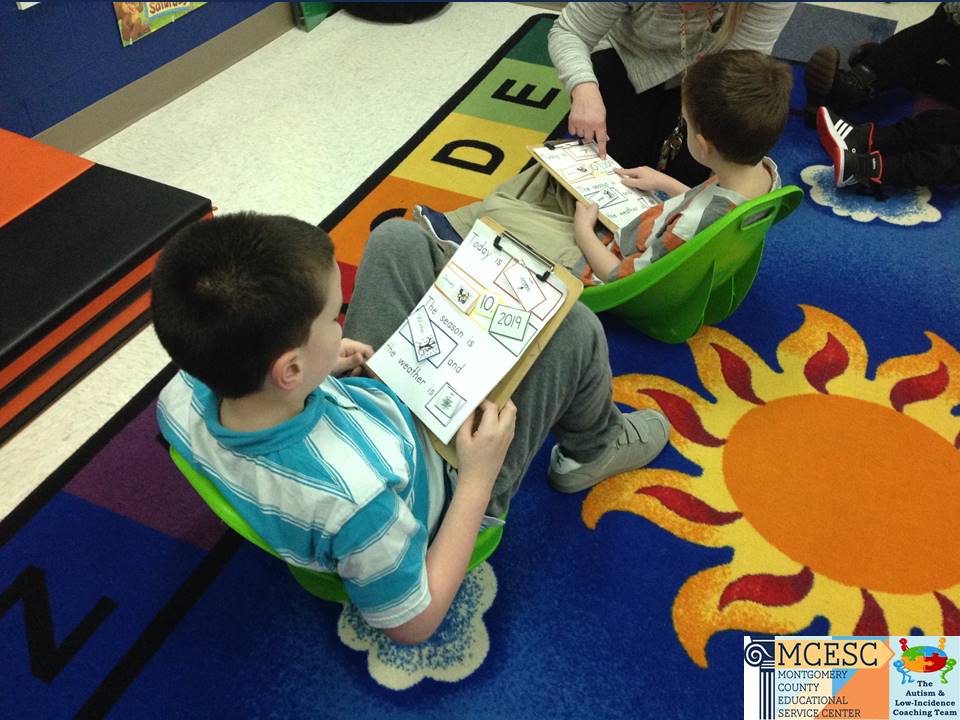
Provide students with an interactive book or clipboard related to the group discussion. Each student can have their own or you can pair students so a stronger student can model and cue a student who struggles.


Circle Time Clipboards and Adapted Seating
Amy Beanblossom
Arcanum Elementary, Arcanum


Here is a video of a teacher priming her new kindergarten student to use an interactive calendar book. The video and book were sent to the student’s parents over the summer to practice using the book prior to their child starting kindergarten in the fall. This would also be a good tool to send home if a student is joining the morning group virtually.


Circle Time Book

Proactively planning and implementing these supports can help all your students engage in group learning and participate with success!