Showing posts with label progress monitoring. Show all posts

Tuesday, September 3, 2024

Best Blog Posts for Classroom Organization

To start this school year, our team is compiling some of our best examples of supports we have seen in our districts and featured in previous blog posts. Today we are highlighting all of our Best Organization Station Blog Posts for Classroom Organization. 


Click on the hyperlink under each heading below to be taken to the related post on that topic.


Monday, December 6, 2021

Organization Station: Data Collection Reminders


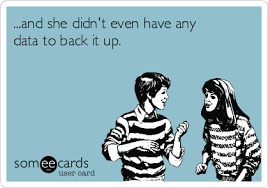
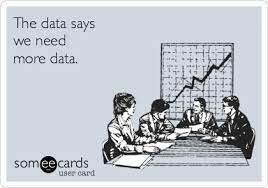
Yep, this pretty much sums up how we feel about data! We know it can be tricky to find time to record data but it is absolutely essential to monitoring progress and planning future interventions. In today's Organization Station we are going to share some of the data collection strategies we have seen when out coaching to hopefully make data collection easier and meaningful. 


Baseline Data

To determine what a student needs, it is important to first determine where they are at through taking baseline data. This could come from ETR testing or classroom assessments. For some skills, a rubric can be a great way to see where the student's current level is and also provides a progression of skills to get to proficiency. 

Communication Rubric
Emily Beck
Bradford Elementary, Bradford


Behavior Data
Often when coaching teams they will report student behavior that is interfering with the student's success at school. Behavior is so tricky because there is often a lot of emotion involved. The truth is, reporting on behavior without data is just an opinion. Taking baseline data on behavior provides a starting point for where to start with behavior interventions and addressing skill deficits and takes the emotion and opinion out of the equation. We love using this scatterplot data collection sheet because it makes it easy to visually see patterns of data and determine when to provide interventions. 

Brandy Beirise
Wayne High School, Huber Heights


Goal-Specific Data
Once baseline data is taken and analyzed, then goals and objectives are determined. Often, teachers will create goal-specific data collection tools to ensure that staff is keeping the goal in mind when working on needed skills. 
Granville Bastin
Preble County ESC


Data Organization

Many of us have been here! We get ready to write an IEP or progress report and realize that we don't have enough data. Or we want to trial a new intervention and realize we really don't have enough data to determine if the current interventions are being used with fidelity. Creating a system for organizing what data will be taken and who will take it ensures everything gets taken care of. 

Tim Sullivan 
Springfield High School, Springfield

Annette Black
Springfield High School, Springfield

Mandy Schetter
Northmoor Elementary, Northmont

Keep data collection materials in a designated area for easy access by teachers, paraprofessionals, and related service personnel. Using the same data collection sheets can reduce discrepancies and allow for easier collaboration and problem-solving. 
Rylie Jarrett
Stevenson Elementary, Mad River

Jackie Vollmer
Driscoll Elementary, Centerville

For more great ideas from our regional classrooms for data collection don't miss our previous posts:


Monday, October 25, 2021

Organization Station: Delegating Responsibilities to Paraprofessionals

In many special education classrooms, paraprofessionals are essential team members who ensure the safety of students, assist in learning activities, and aid the teacher in managing classroom tasks. Often when we encounter teachers who are overwhelmed by their workload, we recommend looking at the tasks they are trying to handle by themselves and determining which can be delegated to their paraprofessionals. Not only does this reduce burnout but it also allows the paraprofessionals to learn more about the ins and outs of the classroom and increases the sense of teamwork and classroom community. Today's Organization Station features some of the ways we have seen responsibilities delegated to paraprofessionals in our referral classrooms. 


Learning Activities

Paraprofessionals can assist during learning activities through assisting students during inclusion and group activities or leading their own small group or 1:1 learning. Clearly communicate expectations through schedules, lesson plans, and zoning plans. 

Daily Center Schedule
Jackie Vollmer
Driscoll Elementary, Centerville

Daily Center Schedule
Amy Beanblossom
Arcanum Elementary, Arcanum-Butler

Daily Detailed Staff Schedule
Amy Beanblossom
Arcanum Elementary, Arcanum-Butler

Additionally, provide materials and space for paraprofessionals to organize what they need to successfully support students. 

Staff Lesson Materials
Jackie Vollmer
Driscoll Elementary, Centerville
Inclusion Student Materials
Mandy Schetter
Northmoor Elementary, Northmont

Math and Reading Practice Materials with Directions
Jamie Minnish
Prass Elementary, Kettering

Data Collection

In many of our classrooms, paraprofessionals share the workload when it comes to taking student data. This is a great way to help students work on skill generalization across staff and it can be so helpful for lightening the load of the intervention specialist. 

IEP Goal Sign Up Board
Tim Sullivan
Springfield High School, Springfield

Daily Traveling Data Collection Sheet
Mandy Schetter
Northmoor Elementary, Northmont

AAC Vocabulary Programming List
Jackie Vollmer
Driscoll Elementary, Centerville

Student Goal Visual Reminders
Karyn Smith
Tri-Village High School, Tri-Village


Material Preparation

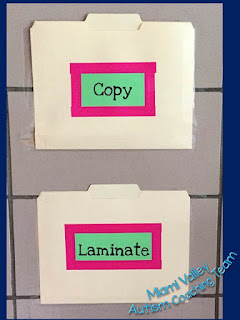
In the special education classroom, there never seems to be a shortage of materials that need prepared by making copies, laminating, or assembling. Then, finding time to store or organize these materials takes time too! Delegating this responsibility allows paraprofessionals to preview learning materials and better understand where everything is located within the classroom. Having a designated system for material preparation ensures that staff always know where to go to find what needs to be done. This is perfect for those last-minute times when a student may be absent or staff has time during a whole group lesson (if they aren't needed to help with students at that time of course!). 


Staff Communication Corner with Material Prep Organization and Materials
Molly Magoteaux
Kleptz ELC, Northmont

Folders for Copies and Lamination
Jamie Zimmer
Kettering Middle School, Kettering

Material Prep Organization
Lindsey Woods
Fairborn Primary, Fairborn

Material Prep Organization
Rylie Jarrett
Stevenson Elementary, Mad River


Daily Tasks

Often classroom teachers' heads are spinning with all the things that need to be remembered and decisions to be made. This can make it challenging to remember daily tasks that are not part of the learning routines. Delegating these tasks to paraprofessionals can make sure nothing is forgotten throughout the day!

AAC Charging Reminders

Papers for Daily Folders
Jamie Minnish
Prass Elementary, Kettering

Weighted Vest Schedule
Nicia Cook
Kenwood Elementary, Springfield

Student Schedules for Setting Up Interactive Visual Schedules
Amy Beanblossom
Arcanum Elementary, Arcanum-Butler

For more ideas on working with paraprofessionals, don't miss our previous posts:


Monday, November 11, 2019

Organization Station- More Ideas for Data Collection

Teams ask us all the time about the best methods for data collection. There are so many options available that it can definitely be a challenge to find methods that are both efficient and thorough. In today's Organization Station, we have gathered some great ideas from around the Miami Valley to help make this decision easier.


General Data Collection
Our first examples are pretty general and can be used to gather data on any goal. They are great for quick data collection! While they work well for individuals who know the student's IEP goals really well (such as their Intervention Specialist) they may be a more challenging method for other staff members who are less familiar (such as paraprofessionals or support staff).

Using color-coded post-it notes, this IS records data on her clipboard and then transfers it to color coded sheets on the wall. This data can later be transferred to an IEP program or data binder.


Amy Beanblossom
Arcanum Elementary, Arcanum
A similar approach is the use of shipping labels that can be used to gather data for a variety of students at one time and then transferred to their respective data binders later. This is a great system for data collection during a group activity.

Ann-Marie Small
Driscoll Elementary, Centerville


This is another basic sheet that can be used to record any goal and is organized to record two goals per student. Goals can be written in ahead of time to provide more guidance if you want to use this type of system with support staff or paraprofessionals.

Laurie Maravetz
Schaefer Middle School, Springfield


Behavior Data Collection
When it comes to behavior data, it is important to target specific behaviors that you want to monitor. This is especially important when a student engages in a variety of interfering behaviors. Prioritize the behaviors to focus on starting with the most dangerous, then those that are destructive, then disruptive, and finally distracting. It is also important to be specific so that all staff knows exactly what behavior to monitor and track.

When we are initially looking for patterns of behavior we recommend scatterplot data collection. The scatterplot can look at a whole month's worth of data and can determine if there are patterns to the time of day or day of the week the behavior occurs. It is easy to track because you do not need to track the frequency or specific instances of behavior. You only need to determine if the behavior occurred within a 15 minute period. We recommend assigning each behavior being tracked (between 2-3 behaviors at a time) a colored highlighter. This is a very visual data collection tool which allows you to present it without added work and it can be quickly analyzed.


Rylie Jarrett
Stevenson Elementary, Mad River

Angie Kleinhans
Stebbins High School, Mad River

This data collection tool can be used as a scatterplot to track several targeted behaviors across the day for a week. Like the scatterplot above, staff can simply mark the box if the behavior occurs during the time given.
Mary Nolan
Valley Forge Elementary, Huber Heights

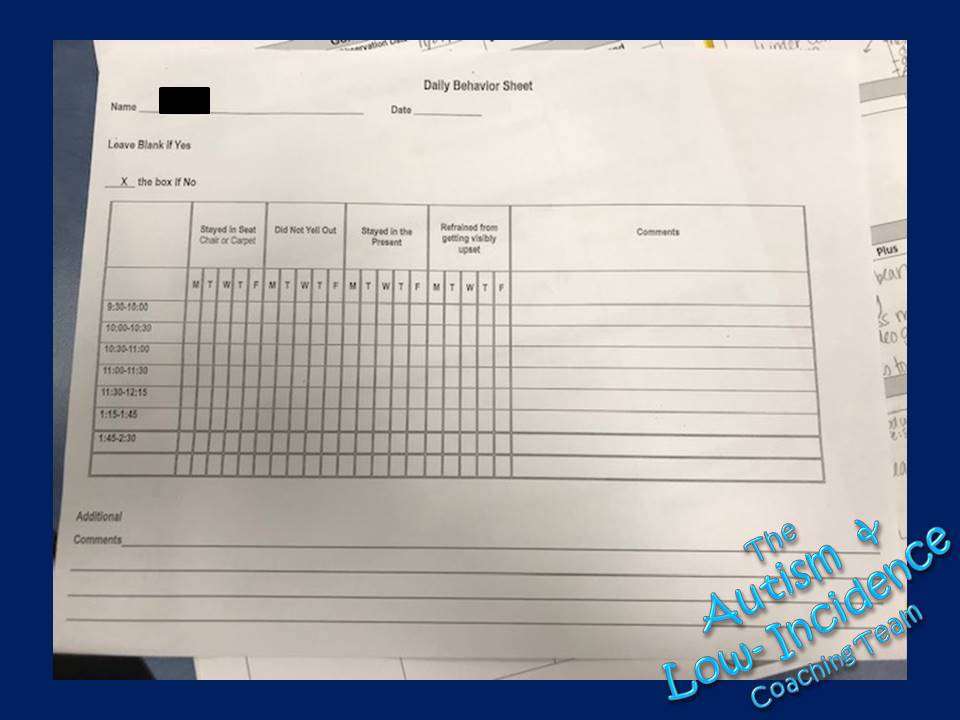
Some teams use individual behavior plans as a way for students to monitor their behavior throughout the day as well as a way to collect behavior data. As mentioned above, specific behaviors should still be prioritized to help the student know what to work on and to help staff know what to prioritize. Rather than listing the negative behaviors and tracking frequency, staff should list what they want the student to do instead and track their success with applying the replacement behavior. When a student has a variety of behaviors, it can feel overwhelming to them and to staff to try to tackle everything at once. So start with small, manageable steps.

These smiley face behavior sheets can be modified to include 1, 2, or 3 separate behaviors.

Debi Gnau
Mad River Preschool, Mad River
Leslie Mann
Demmitt Elementary, Vandalia

These point sheets are similar examples of tracking specific replacement behaviors. When using a behavior system, many teams have students set goals for students to meet. When these goals are met, students typically earn a motivating item or activity. Make sure these expectations are clearly communicated. Use the data from the behavior sheets to determine the frequency of reinforcement needed. Do they need multiple rewards daily...
Mary Nolan
Valley Forge Elementary, Huber Heights

at the end of the day...
Heather Balkcom
Springcreek Primary, Piqua


or weekly?
Korie Jacobs
Mad River Middle School, Mad River

Self-Management
Some teams use data collection to determine the effectiveness of supports they have implemented. We frequently see this type of data collection for sensory and self-management supports. Sometimes this data is taken by staff. It can be analyzed to determine if new strategies are needed or if the frequency of providing supports needs modified.
Rylie Jarrett
Stevenson Elementary, Mad River


Or students can begin self-monitoring their self-management strategies. Self-monitoring is a great strategy in this area to help students begin recognizing how well they are implementing the strategies they have learned so they become more self-aware of their needs.

Leslie Mann
Demmitt Elementary, Vandalia

Michele Glynn and Kathy Healy
Minneapolis Public Schools

Michele Glynn and Kathy Healy
Minneapolis Public Schools

Check out our favorite book on data collection for more ideas: