Showing posts with label home base. Show all posts

Tuesday, December 10, 2019

Regulation Rendezvous: Home Base

Problems related to stress and anxiety is common in children and youth with autism. Stress and anxiety in these children is often triggered or results from:
  • environmental stressors
  • difficulty in predicting outcomes of everyday events and behaviors
  • an inherent emotional vulnerability
  • misperception of social events
  • rigidity in moral judgment that results from a very concrete sense of social justice violations
The stress and anxiety experienced by individuals with autism may manifest as withdrawal, reliance on obsessions related to circumscribed interests or unhelpful rumination of thoughts, inattention and hyperactivity. It may also trigger aggressive or oppositional behavior.
One beneficial intervention involves making the school environment as stress-free as possible by providing a student with a “home base.” Today's Regulation Rendezvous will provide more information on providing this support and examples from around the Miami Valley.


A home base is:

  • A place in the school where the student can “escape” both environmental stressors and social demands. The home-base should be quiet with few visual and/or auditory distractions. Activities engaged in this area should be selected carefully to ensure that they are calming rather than alerting. In school, resource rooms or counselors' offices can serve as a home-base.

Vicki Gomes
Miami East Junior High, Miami East

Angela Crum
Fairbrook Elementary, Beavercreek

Springcreek Primary, Piqua


Taylor Ruef
Stevenson Elementary, Mad River

Nikki Tinnerman
Kleptz ELC, Northmont

  • Regardless of its location, it is essential that the home-base is viewed as a positive environment. Home base is not “timeout” or an escape from classroom tasks. Many teams find incorporating special interests or having the student decorate their home base can help them view the support more positively.
Greene County ESC

Lori Bicknell
Mound Elementary, Miamisburg

  • The student can take schoolwork to home base in order to finish the task in a less intense setting. For some teams creating the home base location within the classroom can make it easier for the student to access and limits disruptions to their learning. Typically teams will create the space using visual boundaries such as a study carrel or physical divider.
Wendy Sondergaard
Rushmore Elementary, Huber Heights

Jamie Minnish
Prass Elementary, Kettering

Beth Young
Snyder Park Elementary, Springfield

Ashley Holtz
Kleptz Elementary, Northmont

Traci Parker
Forest Elementary, Troy

Jennifer Jette
Vandalia-Butler High School, Vandalia

Kara Cripe
Smith Elementary, Oakwood

Greene ESC
  • Home base may be used at a variety of times within the school day 
    • at the beginning of the day
    • to preview the day's schedule
    • to introduce changes in the typical routine
    • to ensure that the student’s materials are organized or prime for specific subjects

  • At other times, home base can be used to proactively decrease levels of stress/anxiety by helping students recover from times of day that may be most stressful and difficult to regulate.  For many students with autism, less structured times of the school day such as specials, lunch, recess, or assemblies increase their stress/anxiety due to the increased exposure to sensory stimuli and added social demands.
  • Home base can also be used to help a student gain control after a meltdown.


For additional information, visit the Home Base module on the Autism Internet Modules at www.autisminternetmodules.org

Wednesday, April 18, 2018

Regulation Rendezvous-- Calming Sensory Rooms featuring Bell Haven PreK-6 School and Rosa Parks ELC, Dayton

We recently had the pleasure of seeing the Calming Sensory Rooms at Bell Haven PreK-6 School and Rosa Parks Early Learning Center in Dayton Public Schools. It is fantastic to see these buildings prioritize these sensory supports for their students and dedicate space and funds for the equipment.

On today's Regulation Rendezvous we will share some pictures of each building's Calming Sensory Room as well as some tips from our OT, Lynn DeMange, on setting up a calming sensory room.


Most of the equipment featured is from the local manufacturer of sensory integration equipment, Southpaw. Visit their website at https://www.southpaw.com/ for more information and ordering.

First up is the room at Bell Haven PreK-6 School.

Zones of Regulation visual on door

marble panel 
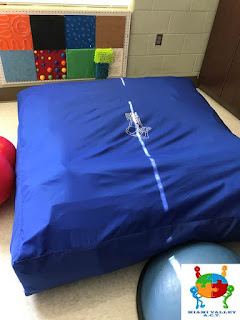
sensory rocker


cloud nine

Fiber Optic Tunnel

bubble tube with platform

fiber optic tunnel, bean bag chair, and stereo rover with projector

steamroller and bubble mirror


Next is the Calming Sensory Room at Rosa Parks Early Learning Center:

ball pit and bubble tube

bean bag with fiber optic strands, cloud nine, and color panel

activity panel

sensory rocker, marble panel, stereo rover with projector, and bubble tube with platform

bubble tube with platform

fiber optic strands with platform

If you are thinking about creating a Calming Sensory Space for your school, Lynn has the following recommendations:

Top 10 Tips for Creating a Calming Sensory Space

  1. Cut down on visual and auditory clutter with clearly defined areas. Larger rooms sometimes benefit from the use of dividers to separate spaces. 
  2. Be careful not to schedule too many students in the sensory room at once. This can lead to a calming break actually being too alerting!
  3. Music should be instrumental and played softly.
  4. Use dim lighting to reduce visual overstimulation. 
  5. Students with ASD sometimes struggle with unstructured sensory breaks. Use visual supports and schedules in the sensory room to provide structure and reduce the need for auditory cues.
  6. The calming sensory space can be used as a proactive support through embedding breaks into the student's schedule. Frequency varies depending on a student's individual sensory needs, however one break in the morning and one break in the afternoon is a great place to start. 
  7. Additional breaks can be recommended by staff or initiated by the student.
  8. Use calming seating options such as a rocking chair, vibrating chair pad, or 2-point suspension swing for vestibular input or a bean bag chair or cloud nine for proprioceptive input. 
  9. Weighted items such as a heavy stuffed animal, lap pad, or weighted blanket are also calming. 
  10. Going to a calming sensory space should be viewed in a positive way and not associated with punishment or "time out".

Wednesday, October 11, 2017

Regulation Rendezvous-- Stevenson Elementary Calming Sensory Space

Dealing with the myriad of sensory information within the school setting can be very challenging for a student with autism. When a student with autism experiences sensory overload, (s)he may have a behavioral meltdown. One strategy to avoid or help a student recover from a meltdown includes the use of a calming sensory space. On today's Regulation Rendezvous, we have featured the Calming Sensory Space at Virginia Stevenson Elementary in Mad River Local Schools. 


ALIST teacher, Emily Ottmar, has worked with her school OT, Denise Campbell, and has consulted with our OTs Lynn and Susan to create a fantastic space for students to feel safe and comfortable while at school. ALIST principal, Cory Miller, supported Emily's efforts and continues to strive to meet the diverse needs of the Stevenson students. 

The Calming Sensory Space at Stevenson has minimal alerting sensory input including decreased lighting and noise. Students at Stevenson use the Calming Sensory Space proactively and it is viewed positively and never as punishment or "time out". It can be included in their daily schedule, recommended by an adult, or initiated by the student with permission.


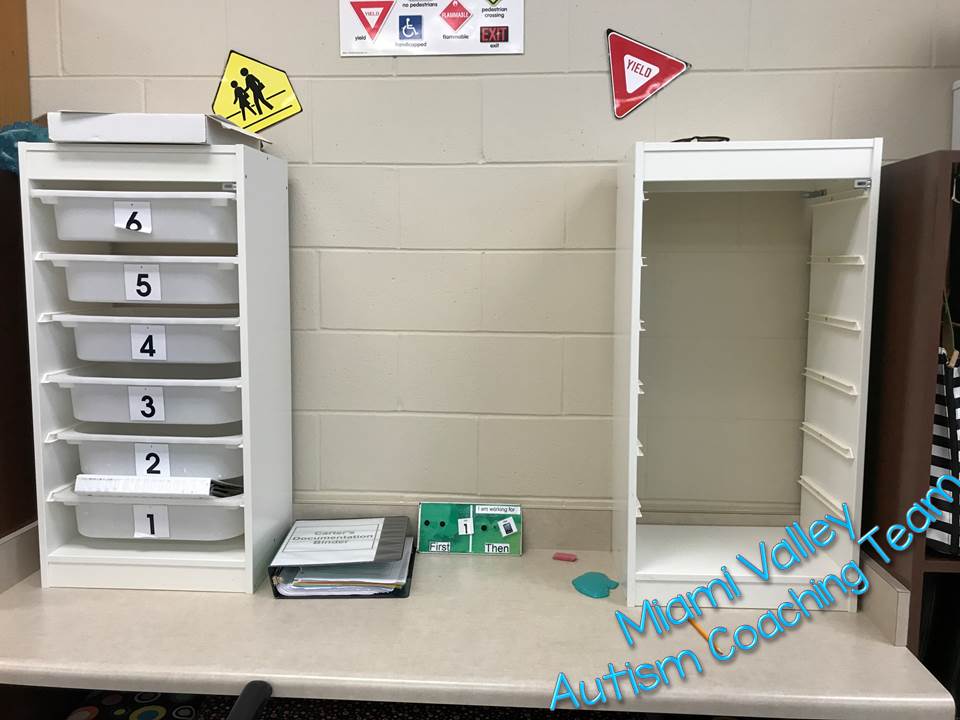
The Calming Sensory Space is divided into 6 separate locations within the room. Upon entering the room, students choose where they want to go using the choice board below. Only one student can be in each space at a time to ensure minimal input and distractions.


Extra materials and shelving is covered to limit visual clutter.

Each location within the Calming Sensory Space has clearly defined expectations and directions on how to clean up. It also provides an inventory of what materials should be in the space. Spaces are divided using shelving, flexible folding mats, or classroom dividers.


Tunnel

The tunnel provides proprioceptive input for students who want to lay on their stomach while looking at a book or completing a puzzle. Students can lay within the tunnel for decreased visual stimuli from the rest of the room. 


Peapod Chair

The peapod chair provides proprioceptive input through calming deep pressure as students sit within the pod. 


Saucer Chair and Beanbag

These seating alternatives are also proprioceptive options to give students a comfy place to look at books or play with fidgets.


Small Bean Rocker

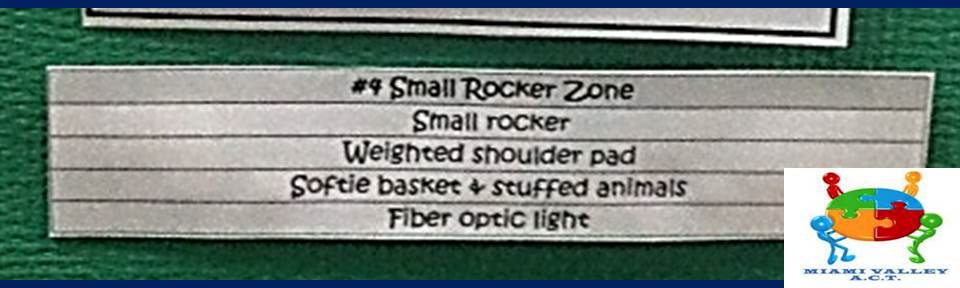
The bean rocker is great for young students who want to get vestibular input through rocking in this cozy spot. 


Large Rocking Chair

Older students can rock in this large rocking chair to get calming linear vestibular input. 


Hammock Swing

Students get vestibular input through the hammock swing. Adults monitor the swing to make sure students swing back and forth for calming linear input instead of rotating which can be alerting. 


In addition to the Calming Sensory Space, teachers at Stevenson can check out calming items to trial in their classrooms including weighted shoulder and lap pads, vests, fidgets, and seat cushions.


Monday, September 25, 2017

ALIST Spotlight-- Jane Chance Elementary

We are excited to dedicate this month's ALIST Spotlight on Jane Chance Elementary in Miamisburg! Jane Chance has many excellent ALIST educators dedicated to meeting the needs of their students with autism and low incidence disabilities. Toni Mallot and Carrie Prickett are the amazing leaders of the Jane Chance team. In addition to these wonderful teachers, there are also several great paraprofessionals on their team including ALISTers Monte Wilhelm and Michelle Anspach. This team is also supported by ALIST principal Dale Geyer.


Toni and Carrie both teach in self-contained classrooms for students with autism and low-incidence disabilities. They make up a great team with Toni teaching the earlier grades (K-2) and Carrie teaching the higher grades (3-5).

Both teachers use the evidence-based practice of visual supports for a variety of classroom supports included individualized, interactive schedules:


And routines:


Visual supports can even be an effective support for the adults too! They use visuals to keep lesson materials organized through labels and color-coding. Their expert organizational skills help keep their classrooms flowing and students learning.


Carrie and Toni also use of one our favorite supports of structured work systems:


The Jane Chance team also knows the importance of keeping students internally regulated. They use the evidence-based practice of exercise:


And they also have a great calming sensory room that students can go to during scheduled sensory breaks to help with self-management.


As well as equipment and materials within their classrooms for students who need a break.


Toni and Carrie also use a variety of published and teacher-made materials for their lessons. These materials are hands-on and engaging to meet a variety of student needs. One area they are experts in is the use of the PCI Reading Program.


We want to thank the Jane Chance team for being such wonderful examples of best practices in our region. A special thank you to Toni and Carrie for welcoming fellow teachers into their classrooms as ALIST partners so we are able to showcase their great work for others!