Showing posts with label fine motor. Show all posts

Tuesday, January 14, 2025

Simple Fine Motor and Sorting Taskbox Ideas

When introducing work times with students, whether during one-on-one time with staff or using the structured work system for independent work, we often recommend starting with very basic "put in" tasks. But what is the next step after these tasks are mastered? Today's Taskbox Time features ideas for Simple Fine Motor and Sorting Tasks to continue developing basic work skills with students.


Simple Fine Motor Taskboxes

Once students master the basic put-in tasks where they have a field of one item to put in one location, you can introduce more complex concepts. You can easily adjust complexity based on student needs by removing container lids (easy), cutting a hole or slot into the lid (medium), or cutting slits to provide resistance for the student to push the item through the lid (hard).

Take Off and Put In Tasks

These taskboxes require students to use fine motor skills to take an item "off" the taskbox and place it in a designated location. 
Take velcro'd bears off lid and place in container
Allison Officer
Stevenson Elementary, Mad River

Take clothespins off box and put in to container
Allison Officer
Stevenson Elementary, Mad River

Take pegs out of box lid and place in container
Allison Officer
Stevenson Elementary, Mad River

Pull beads off pipe cleaner and put into container
Allison Officer
Stevenson Elementary, Mad River

pull small beads off pipe cleaner and place into box
Allison Officer
Stevenson Elementary, Mad River

Pull velcro'd blocks off container side and place in top opening
Allison Officer
Stevenson Elementary, Mad River

Pull velcro'd legos off container side and place in top opening
Lauren Dickey
Indian Riffle Elementary, Kettering


Put On Tasks

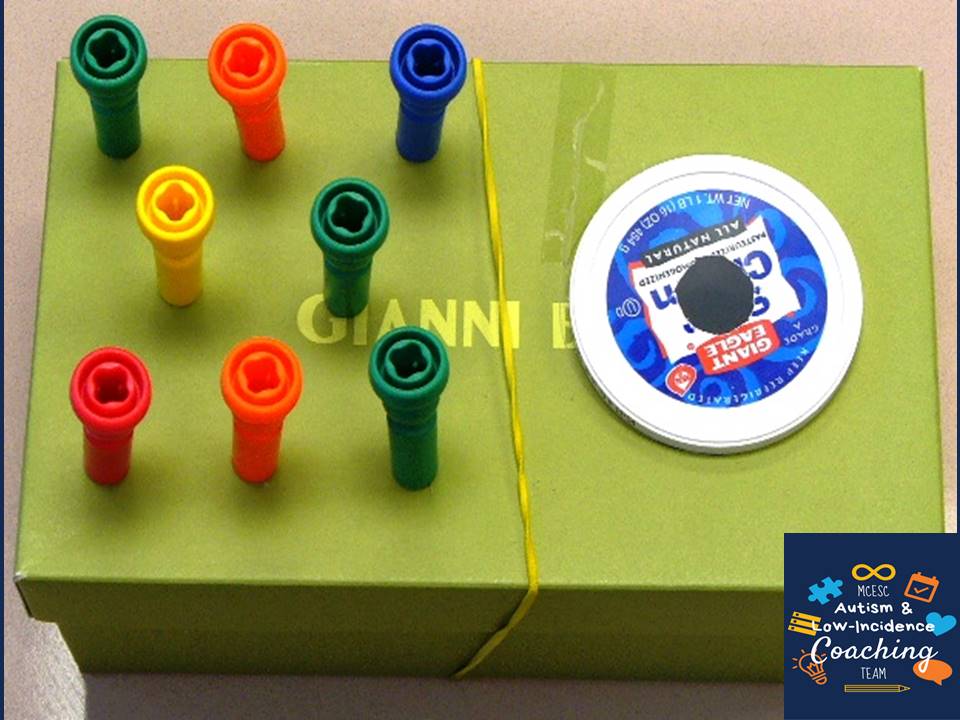
These tasks require more coordination to place an object on the designated peg. Trial a variety of object, hole, and peg sizes. Larger holes will make it easier for students to place the objects on the peg. 

Wooden Ring Stacker
Jackie Vollmer
Driscoll Elementary, Centerville

Mason jar rings on paper towel tube
Jackie Vollmer
Driscoll Elementary, Centerville


Basic One-to-One Correspondence

It is important at this stage of 1:1 correspondence that any object being used fills the entire space in the container so multiple items aren’t placed in the same space.

Wiffle balls in muffin tin
Allison Officer
Stevenson Elementary, Mad River

Wiffle golf balls on tubes
Kristen Johnson
Greene County INC, Greene County


Introductory Sorting

When first introducing sorting, it can be helpful to use items that have many very obvious differences such as different sizes, shapes, textures, and/or colors. Simply sorting by shape, color, or size is too complex at this initial stage. The greater the number of differences, the easier the sorting task will be. 

Sort wooden blocks vs. rubber bouncy balls

Sort wooden blocks vs. plastic bristle blocks
Jackie Vollmer
Driscoll Elementary, Centerville

Sort pom-poms vs. buttons

Sort pom-poms vs. wooden blocks
Allison Officer
Stevenson Elementary, Mad River


Sort Bowls and/or Cups
Allison Officer
Stevenson Elementary, Mad River

For easier taskbox ideas, check out our previous posts:

For more complex taskbox ideas, check out these previous posts:


Tuesday, October 19, 2021

Taskbox Time: Seasonal Taskboxes

Do you have students who master taskboxes quickly or get bored easily with repetitive tasks? Seasonal taskboxes are a great way to incorporate basic skill practice in a novel way each season! Today's Taskbox Time features taskbox ideas from across the Miami Valley for every season!


Summer
Pineapple Water Bottle Straw Task (Fine Motor)

Ocean Animal Subtraction Task (Math)
Laura Frank
Valley Forge Elementary, Huber Heights

Fruit Sorting Task (Sorting)


Fall
Buckeye Necklace Task (Fine Motor/Vocational)
Kirsten Johnson
Greene INC, Greene ESC

Spider Rings on Pencil (Fine Motor)
Debi Gnau
Mad River Preschool, Mad River

Spiders in Yarn Web Tong Task (Fine Motor)
Tracey Cooper
Tecumseh Elementary, Clark ESC


Winter
Candy Cane Pipe Cleaner Beading Task (Fine Motor)
Robbie Whorton
Trotwood High School, Trotwood-Madison

Mitten Sort Task (Sorting/Vocational)
Laurie Maravetz
Schaffer Middle School, Springfield

Holiday Cookie Sort Task (Sorting)
Debi Gnau
Mad River Preschool, Mad River

Calendar Picture Matching Task (Matching)

Felt Christmas Tree Task (Fine Motor)
Rylie Jarrett
Stevenson Elementary, Mad River

Valentine's Day Heart Tangram Task (Matching/Math)
Debi Gnau
Mad River Preschool, Mad River


Spring

Garden Glove Match with Clothespin Task (Matching/Fine Motor)

Easter Egg Matching Task (Matching/Fine Motor)

Baby Animal Packaging Task (Packaging)

Easter Egg Figuring Packaging Task (Packaging)

Tuesday, April 27, 2021

Taskbox Time: Even More Fine Motor

This is actually our fourth Taskbox Time post featuring fine motor tasks! Fine motor tasks seem to be some of the most popular taskboxes we see in our districts. Often, these activities can be taught to beginning learners and make a great candidate for independent work times because they are repetitive and predictable. Some of our students even find fine motor tasks to be calming and organizing so they can be used during unstructured time or when the student needs reduced task demands due to emotional or behavioral regulation needs. 


letter pegboards
Debi Gnau
Mad River Early Childhood Center, Mad River

plastic nuts and bolts
Debi Gnau
Mad River Early Childhood Center, Mad River

owl lacing beads
Debi Gnau
Mad River Early Childhood Center, Mad River

shape form puzzles
Jamie Minnish
Prass Elementary, Kettering

burger sequencing task
Jenna Fitch
Demmitt Elementary, Vandalia

spider ring task
Debi Gnau
Mad River Early Childhood Center, Mad River

felt Christmas trees
Rylie Jarrett
Stevenson Elementary, Mad River

spider web tweezer task
Tracey Cooper
Tecumseh Elementary & Clark ESC


To see our previous fine motor taskbox posts click the links below:

Put-In Tasks

Fine Motor

More Fine Motor

Fine Motor at Home

Thursday, January 14, 2021

Academic Area: Writing

What better way to start a new year than to introduce a brand new blog series! We see so many awesome examples of differentiated and multisensory academic activities when we are out in classrooms that we thought what better way to showcase all of these great ideas than to give them their very own spot here on our blog! Introducing our Academic Area!


For our very first Academic Area post, we want to share all the wonderful examples we have for writing instruction ranging from basic handwriting to supports for paragraph writing. 

Handwriting

Many of our students with autism and low-incidence disabilities struggle with fine motor skills which can make handwriting a challenge!  

The use of tracing and copying tasks is a great way to differentiate for students who need to focus efforts more on the task of writing and less on recalling spelling. 

Jamie Minnish
Prass Elementary, Kettering


Differentiated Name Writing Tasks
Renee Vaughn
Studebaker Preschool, Huber Heights

Name Writing Morning Work Mats
Darlene Hays & Andy Krickenbarger
Anthony Wayne Preschool, Darke County ESC

Since many learners with autism are very visual learners, they can easily copy how a letter or word looks visually, however they may not use the correct letter formation. It is important to provide consistent, direct instruction of letter formation to prevent any poor handwriting habits. Use of systematic, multisensory handwriting curriculums such as Fundations or Handwriting without Tears are a great support for students who need this direct instruction. 

Fundations Visual Cues
Heather Balkcom
Springcreek Primary, Piqua

Handwriting Without Tears
Tracey Cooper
Tecumseh Elementary, Tecumseh


At times a student's needs are so significant that traditional handwriting is too difficult and a more functional accommodation needs to be made such as a name stamp.

Name Stamps
Catherine Anderson
Rushmore Elementary, Huber Heights


Sentences

There are a variety of skills that go into writing a sentence including generating a thought and putting that thought into words and then writing the sentence on paper with correct conventions. 

For students who struggle with generating a complete thought, using word cards like the examples below can be a great first step. 

Writing task of creating a sentence about a picture using color-coded picture and word cards

Writing task of creating a sentence about a picture using word cards
Laurie Maravetz
Schafer Middle School, Springfield


Once the student begins writing sentences, provide visual supports to help them self-edit their work such as writing convention rubrics or visual reminders. 

Sentence Writing Visual Reminders
Lindsay Fox Bush
Kemp Elementary, Dayton


Sentence Conventions SWAG Acryonym
Kristen Gregory
Northmoor Elementary, Northmont


Paragraph Writing

As your students develop their sentence writing skills, the next step is paragraph writing. Since writing is so challenging for our students with autism and low-incidence disabilities it is important to scaffold and adjust expectations so they can be most successful. Otherwise, writing can become a contentious and stressful time of day!

One way to motivate students to complete writing activities is to allow them to write about a special interest or favorite activity. This often increases engagement, leads to the student writing more than they typically would, and allows the staff to still see their true writing abilities. 

Special Interest Writing Journal
Lori Bicknell
Mound Elementary, Miamisburg


Graphic organizers can be helpful in supporting students to organize their thoughts and the information they want to include in their paragraph. For some students, the student may dictate while staff writes on the graphic organizer to reduce writing fatigue. 

Topic-Specific Word Wall Graphic Organizer
Kim Hampton
Broadway Elementary, Tipp City

In addition to graphic organizers, provide visual resources for students to use while writing to assist with remembering letter formation or spelling so they can focus on getting their thoughts on paper.

Writing Resource Folder
Lori Bicknell
Mound Elementary, Miamisburg

For some students, the idea of writing a paragraph can be overwhelming because they are unable to visualize what the completed assignment will look like. Providing clear expectations and an exemplar can be a great way to help them better understand what to do. 
Writing Exemplars
Monica Klarer
Indian Valley Intermediate, Greenon

Writing Exemplars
Lindsay Fox Bush
Kemp Elementary, Dayton


Assistive Technology 

When prioritizing writing expectations, you may find that the main goal is for the student to convey what they know about a specific topic rather than demonstrate the physical ability to write. Using a scribe or assistive technology such as typing, voice-to-text, or word prediction software can be a great support for students who struggle with mastering handwriting but still have a lot to say! 


Clicker Writer Word Processing Software
Karyn Smith
Tri-Village High School, Tri-Village

For more ideas on assisting students with autism and low-incidence disabilities during writing instruction we love I Hate to Write: Tips for Helping Students with Autism Spectrum and Related Disorders Increase Achievement, Meet Academic Standards, and Become Happy, Successful Writers by Cheryl Boucher and Kathy Oehler which is full of practical ideas and graphic organizers targeting specific writing challenges.