Showing posts with label OT. Show all posts

Tuesday, May 20, 2025

Regulation Rendezvous: Meeting The Interoceptive Needs Of Individuals With Autism And Other Low-Incidence Disabilities

When working on developing an individual’s interoceptive awareness, individuals engage in activities that focus on inner feelings, which can make it easier to recognize, make sense of, and manage their own personal internal experiences. During our coaching process, our OT, Lynn DeMange often collaborates with other OTs and educational teams who need help supporting a student’s interoceptive awareness. In today’s Regulation Rendezvous, Lynn shared ideas for Meeting The Interoceptive Needs Of Individuals With Autism And Other Low-Incidence Disabilities. 


Studies indicate that practicing becoming more aware of one's internal signals can lead to less anxiety, make it easier to understand and talk about one’s emotions, and improve one’s ability to handle their feelings.

http://missjennyot.com 

Meeting an individual’s interoceptive needs helps them gain a deeper understanding of themselves. When developing interoceptive awareness, activities should focus on guiding individuals through a process of self-discovery. As Kelly Mahler recommends, this can be achieved through:

  1. Paying attention to what one’s body is telling them.

  2. Figuring out what those body signals mean.

  3. Learning what one can do to change how their body feels

Helping individuals learn about their own unique interoception works much better than past methods that try to tell someone what they "should" be feeling. It's not accurate to say that everyone feels anxiety or hunger in the exact same way. It's different for each of us, so we need to approach it in a way that's tailored to the individual.

Autistic individuals and those with low-incidence disabilities often go through life with their inner feelings being misunderstood, labeled incorrectly, or even dismissed. They can end up feeling internally confused. Plus, the pressure to comply and fit in teaches them to ignore or hide what they're truly feeling just to please others.


So, when we work on interoception with autistic individuals or individuals with a low-incidence disability, often we need to "unlearn" some things before we can really start. This means helping each person feel calm and secure enough to start noticing, reconnecting with, and trusting what their body is telling them again. It's really important to use an approach that understands trauma and focuses on regulation when guiding someone through interoception activities. We need to constantly reassure them that there's no right or wrong way to feel, and that their own inner experience is always real and valid.

Back to School: 17 Tips to Help Autistic Kids | Autism Speaks

Developing interoceptive awareness can work well even for people who don't communicate verbally. To best support non-speaking individuals in understanding their interoceptive awareness, some key first steps include:

  • Help them feel calm and secure: Make sure the individual feels safe and regulated, both internally and with your support, so they can tune into their body.

  • Keep things consistent: Make the exercises predictable, use similar elements each time, and try to make them a regular part of their routine.

  • Use their communication methods: Adapt to how the individual communicates. This might involve using pictures or AAC devices to help them express themselves.

  • Believe in their ability: When interoception activities are presented in a way that fits how someone learns, they can do really well. Sometimes things won't go as expected, and that's alright. When that happens, it's better to think it's something about how we taught it, not about the individual's ability to learn.

  • Listen to non-speaking voices: Look for resources created by non-speaking individuals to really understand their experiences and how to best support them.

Want to learn more about interoception? Check out these resources:

Interoception Websites and Blog Posts


Interoception Journal Articles

Tuesday, October 22, 2024

Join us at OCALICONLINE 2024

We are excited to announce that our proposals have been accepted for OCALICONLINE 2024 this year!


What is OCALICONLINE?

OCALICONLINE 2024 is the premier autism and disabilities conference presented by OCALI (Ohio Center for Autism & Low-Incidence Disabilities).

The online event features breakout and networking sessions by state, national and international leaders and experts on important topics and issues across disabilities and across the lifespan.

Join colleagues and peers from Ohio, across the U.S., and around the world to learn, connect, and share research, best practices, and resources to support the needs of all learners and lifelong challenges and opportunities for people with disabilities.


When is OCALICONLINE?


Join us virtually from November 19-22, 2024.


What are ACT's sessions this year?

Check out our session descriptions for more information on our sessions.


Tools to Communicate with Paraprofessionals for Smooth Sailing in Your Classroom

Thursday, November 21st from 10:00am-11:00am

Are you a teacher who manages one or more paraprofessionals in your classroom? This session will provide tools and strategies to help your team work smoothly in and out of the classroom. Effective communication is crucial when managing paraprofessionals. Develop a positive and supportive relationship with your paraprofessionals to help them effectively support your students. Paraprofessionals are encouraged to collaborate with their teacher or take materials back to share with their colleagues.


Give Me A Break: Troubleshooting Common Challenges During Breaks To Increase Transition Success

Friday, November 22nd from 10:00-11:00am

During previous OCALICON sessions we have emphasized the importance of structuring the different types of breaks throughout a student's day to differentiate between reinforcement, sensory, and in-the-moment breaks. We often hear from school teams that the hardest part of implementing breaks is structuring the breaks in a way that makes it easy to transition students back to scheduled activities, especially work times. In this session, we will address some of the common management challenges during breaks and provide some practical examples for addressing those challenges.


Where can I register?

To learn more and to register to attend, visit the OCALICONLINE website: https://conference.ocali.org/ 

Tuesday, October 15, 2024

Tuesday, November 28, 2023

What should I expect during the first ACT visit?

If you have never worked with the MCESC Autism & Low-Incidence Coaching Team before, you may not know what to expect when you hear our team is coming to support you. Keep reading to learn more about what to expect!


Our secretary, Mary Fryman, will coordinate the first visit. Then, a coach on our team will come out to begin the coaching process. Coaches are selected based on the needs identified by the school team in the referral paperwork. 
  • Intervention Specialists Allison Officer and Jackie Vollmer specialize in classroom referrals, academic differentiation, and instructional supports. 
Allison Officer

Jackie Vollmer

  • Speech and Language Pathologist Carol Dittoe specializes in functional communication, augmentative and alternative communication (AAC), and social skills. 
Carol Dittoe


  • Occupational Therapist Lynn DeMange specializes in sensory processing, self-management, and regulation supports. 
Lynn DeMange


All of our coaches are Certified Autism Specialists and specialize in behavior interventions.


The role of our coaches is to:
  • offer encouragement and support
  • research and model evidence-based strategies
  • collaborate and brainstorm new interventions to trial with your team
  • analyze behavior and data
  • provide individualized resources, tools, or assessments
  • help your team prioritize interventions
Our role is not to:
  • evaluate or judge your team
  • provide direct service to students
  • consult without input or collaboration with your team
  • make recommendations regarding student placement/LRE or hiring of additional staff


Each visit consists of an observation and a meeting. 

Observation
Observations are typically in-person and last for about 1 hour. 

During the observation, we will try to be discreet to minimize distracting students. During the observation, we want to see as close to a typical day as possible. It is important for us to see existing supports and routines, student behaviors, and anything that may assist us in knowing where our support is needed. 

We tend not to have a lot of discussion with staff during this time because we want to minimize distractions, be respectful of not talking about students in front of them, and want to see an authentic snapshot of the day. 

At times, we may interact with students or even try a couple interventions "in the moment". This helps us get a better idea of what may or may not work which informs our future recommendations. Plus we all worked in classrooms prior to coaching so we love the opportunity to be hands-on with students again! During this time, we encourage classroom staff to observe us. We won't always be there to intervene with students so when we are modeling it can be important for classroom staff to take note of how we work with the student so that they can intervene in the same way in the future. 


Meeting
Following our observation, we will meet with the team. This meeting may be immediately following the observation, later in the day, or on a different day depending on your team's availability. The meeting can be virtual or in-person.

We like to have as many team members as possible attend the meeting since we know that collaboration is essential to success! If it is an individual student referral, we let the school team decide if they would like to invite parents to be in attendance. 


Typically, the meeting will follow the sequence outlined below:

1. Introductions and gathering of contact information: 
  • The ACT coach will send an email with a detailed summary to all members of the team including those who may not have been able to make it to the meeting. 

2. Explanation of the ACT process: 
  • The role of the ACT team is to provide job-embedded professional development specifically tailored to the needs of the referral classroom or student to build the educational team’s capacity in meeting the identified needs. With a classroom referral, we provide global classroom supports that could benefit all or a group of students. We do not give individual student recommendations because we do not have parent permission. With an individual student referral, we are able to give student-specific recommendations. Our referral is good for a calendar year and as we provide suggestions we will check in periodically to see how they are going and see if we need to meet and/or observe again to tweak interventions or brainstorm new ideas.

3. Review what is going well and strengths, interests and reinforcement: 
  • We like to build on strengths, help your team identify some positives in a typically stressful period in the classroom, and learn more about what students (or classroom staff) find motivating. 

4. Review what is not going well/challenges: 
  • When an ACT referral is initiated, it is typically because your team needs some support. Although some venting can occur, we try to keep this time goal-driven and solution-focused. It will help us in determining the desired outcomes of our coaching. 

5. Discuss desired outcomes of the coaching process: 
  • These goals are informal but will guide the coaching process throughout the year-long referral. Consider what staff wants to learn more about and outcomes you want for the student(s) to help everyone be more successful. 

6. Determine initial action steps and provide any recommended tools:
  • We try to keep the meeting focused so that we can get to the good stuff... which is what to do next! We will work with your team to brainstorm interventions. We sometimes provide tools or additional resources for you to trial. 

7. Schedule times for future observations and/or follow-up meeting:
  • Once we provide the recommendations, we want to come back and see them in action! This allows us to model or tweak things as needed and determine the next steps. Typically, we schedule this follow-up visit 4-6 weeks after our initial meeting because research shows this is how long it takes to determine intervention effectiveness. If you trial the intervention and things get worse, PLEASE contact your ACT coach! We don't want you to abandon interventions or struggle between visits. We can provide some triage coaching which keeps the coaching momentum moving forward. 

If you want to prepare ahead of time, gathering some of the following information to share at the meeting can be helpful:
  • Copy of classroom schedule.
  • Examples of classroom strengths, interests, and concerns.
  • List of strategies that have already been tried, successfully or unsuccessfully.
  • Data illustrating behavioral concerns or the impact of trialed intervention
  • Ideas about specific needs/desires for outcomes of the coaching process.
  • Contact information and schedules for all educational team members.
  • Calendar/Planner for scheduling follow-up meetings.

Hang in there! Help is on the way! We will see you soon. 


Tuesday, February 7, 2023

Regulation Rendezvous: Tips for Implementing Sensory Breaks

Sensory breaks are a great support for meeting the regulation needs of students! In today's Around Town Round Up our team Occupational Therapist, Lynn DeMange shares some of her top tips for implementing sensory breaks.


When to use Sensory Breaks:
  • Use Sensory Breaks when the data indicates Sensory is the function of behavior or when Sensory testing indicates the need for sensory breaks
  • Not sure if you should try Sensory Breaks? Check out this chart to see if it describes the student you are trying to support!


When to schedule Sensory Breaks?
  • Best approach - Proactively scheduled
    • Don’t wait until the student is showing signs of escalation or is in a meltdown or crisis, you’ve waited too long!
    • You need to proactively implement Sensory Breaks to help the student maintain regulation across the school day.
  • Should not be contingent upon behavior or work completion. Sensory breaks should be viewed as important as time spent on academics. Promoting and maintaining self-regulation throughout the school day provides the student the opportunity to focus and learn.
  • Generally speaking, all students may benefit from one sensory break in the morning and one in the afternoon.
    • However, this needs to be individualized based on data the team collects when sensory breaks are taken.
    • Frequency and duration may be increased based on individual student needs.

How do I know if the Sensory Break was effective?
  • Participation in sensory breaks should result in students feeling/appearing calmer and more regulated.
  • There should be targeted supports being used during sensory breaks that are intended for each student taking a sensory break.
  • Keep data! Track the schedule, frequency and duration of Sensory Breaks. Note what supports or equipment is being used – was it helpful, why or why not? Analyzing the data you keep will help determine changes that may need to be made to the student’s Sensory Break schedule.

Examples of Sensory Break locations:

Classroom:

Example of a calming area within a classroom where students had alternative seating options, fidgets, preferred books, etc
Nikki Timmerman
Kleptz ELC, Northmont


Example of a “pacing path” in a classroom for students who needed more of an active motor movement break. This student is carrying a weighted ball for additional heavy work during her break.
Brantwood Elementary, Mad River


Hallway:


Example of a clearly defined hallway exercise routine for students to complete before returning back to class.
JFK Elementary, Kettering


Example of “locker shopping” while taking a purposeful walk in the hallway. Then the student had to unload his purchases and bag them up!
Heidi Horner
Miami County ESC


Separate Location:

Sometimes having an assigned job or duty is a great way to embed sensory input while being helpful at school.


Lots of districts are developing exercise-based options for sensory breaks which is another example of a great active motor option while also educating students about types of equipment, how to use them, and how it impacts their body.
Kelly Moberly
Learning Center-East, MCESC

Wayne High School, Huber Heights


Sensory Rooms:
Sometimes pairing an active motor sensory break with a purposeful activity helps slow students down and helps them get the input they need to help calm and organize their nervous systems!


Katie Mlod
Mad River ECC- Mad River


Calming sensory rooms can be a great option for escaping the sensory-rich environment of the classroom and have the opportunity to take a break in a quiet, dimly lit location with a variety of supports such as alternative seating options, calming music, lighting options, weighted supports, fidgets, etc.
Beavertown Elementary, Kettering

Smith Elementary, Oakwood


Interested in implementing Sensory Breaks but just don’t know where to start?
  • Consult the Occupational Therapy staff in your building – they’re a wealth of information and will be able to help direct you to the supports you may need to help support your students!


Friday, December 16, 2022

A-LIST Spotlight: Occupational Therapist Marissa Steinhelfer from Montgomery County ESC and West Carrollton City Schools

It is our favorite time of the month when we feature one of our area's brightest and best educators through our A-LIST Spotlight! This month, we are highlighting Occupational Therapist Marissa Steinhelfer from Montgomery County ESC and West Carrollton City Schools. Marissa does a great job collaborating and problem-solving with her teams at West Carrollton. 


We reached out to Marissa so that she could share a little bit of her expertise for this month's feature. Check out her post below: 

"I am so honored to be featured on this ACT Team Blog!  A little background about me: I am originally from the Pittsburgh, PA area and am a graduate of Elizabethtown College in Central PA.  I have been an occupational therapist for over 20 years.  I spent the first part of my career working with adolescents and adults within an inpatient rehabilitation center of a large hospital where I specialized in the treatment of individuals with traumatic brain injury.  I began my adventure as a school-based occupational therapist in 2018, joining the wonderful team of therapists employed with the Montgomery County ESC.  I am now in my 5th year as a school-based OT, servicing elementary school-aged students within the West Carrollton City School District. 


In my present role, I provide direct skilled OT services for students with identified needs in fine and visual motor skills, sensory processing difficulties, executive functioning skills, and/or self-help skills to help students more successfully access their educational environment.  I also provide consultative support to teachers and staff to facilitate implementation and carryover of strategies into the school day.  I am fortunate to work with truly exceptional teachers, staff, and other therapists!  I am always learning and growing--actively seeking out opportunities to increase my own knowledge and skill set so I can use “best practices” to help my students and teams.  I am so grateful to all of the professionals who have shared their valuable time and resources with me. 

Here are examples of some of the roles I have as a school-based OT:

Helping to embed sensory-motor activities and sensory-based supports into the classroom and larger school environment to help meet sensory and self-regulation needs such as:
  • Motor pathways using colored tape on floors
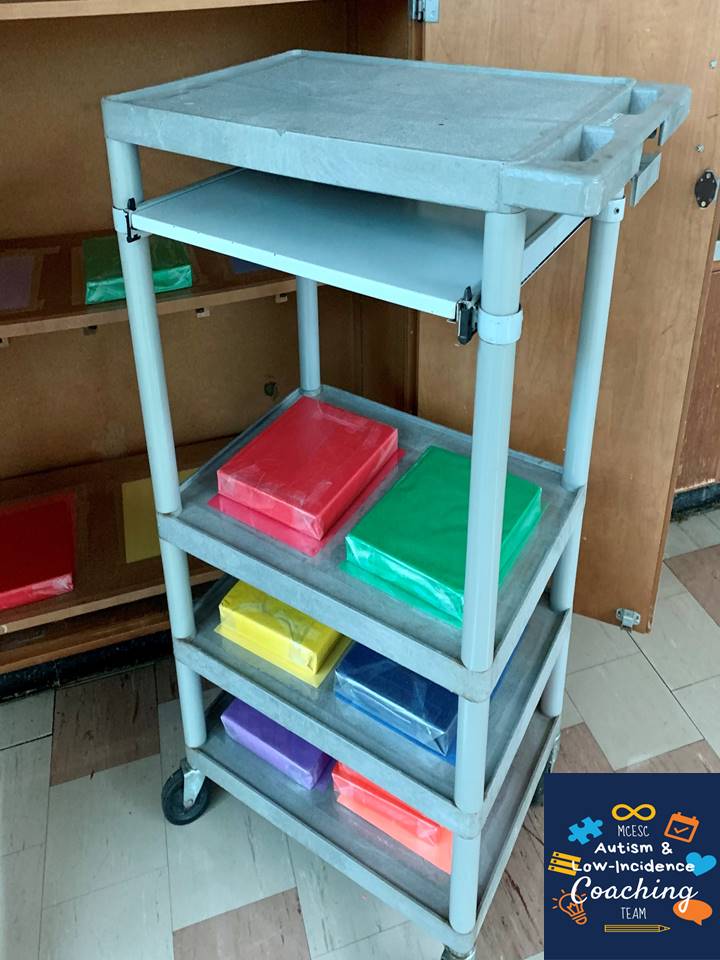
  • Heavy work stations (e.g., colored book carry and sort).  A special “shout-out” to my friends at my local Dayton Metro Library branch who graciously donated out-of-circulation books for me to wrap for use with one of these stations.


  • Movement stations (bend and reach upper/lowercase letter match using Velcro manipulatives; S’cool Moves posters)

  • Purposeful walks that incorporate preferred picture icons related to student interests
  • Trialing sensory-based supports such as flexible seating (ZUMA rockers, resistive kickbands around desk legs, etc.), weighted materials, noise-cancelling headphones, removable under-desk texture board to meet student need for increased tactile input when sitting at desk, etc.

Providing input and activity suggestions for a sensory-motor room
  • Stoplight Choice Board to provide a framework for structuring sensory-motor breaks


  • Activities that provide purposeful movement opportunities to support a student’s need to move while providing regulating proprioceptive input (book cart push/carry/sort; prone scooter board Velcro puzzle)
  • Visual transition sequence of activities to help students prepare for return to class"

We just love Marissa's creativity and ability to individualize supports for her students. Shout out to Marissa for your contribution to this month's spotlight and for all you do for your teams and students. We are so lucky to partner with you!