Showing posts with label writing. Show all posts

Tuesday, February 13, 2024

Academic Area: Predictable Chart Writing

Comprehensive Literacy Instruction is essential in today's classrooms, including self-contained classrooms and cross-categorical resource rooms. In many cases, reading and writing instruction has fallen by the wayside for our most complex learners however the push toward implementing the Science of Reading in all classrooms emphasizes the need for a shift. 

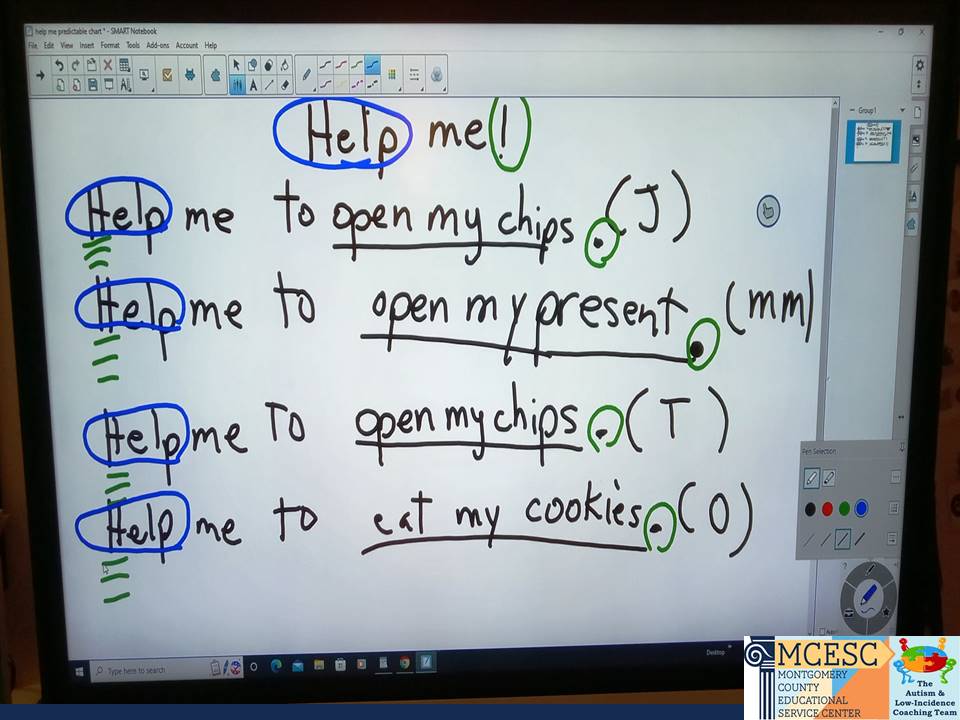
Shared Writing is one component of Comprehensive Literacy Instruction and a highly effective strategy for engaging students with complex needs in shared writing instruction is Predictable Chart Writing (PCW). PCW provides predictability, offers seamless integration of communication, and can be utilized as an activity for the entire classroom, small groups, or even individual sessions. Today's Academic Area post will break down the 5 steps to the Predictable Chart Writing routine. We want to extend a special thank you to Cynthia Resch at MCESC Learning Center-West for welcoming us into her classroom to model each step of the PCW routine for us to share!


Each step in the Predictable Chart Writing Routine takes place during a new session. Typically, this is done during daily writing instruction over the course of a school week. 


Step 1: Write the Chart (Monday)
  • Choose a sentence stem. Possible topics could include the current classroom theme, responding to a recent reading passage, or incorporating the use of core words. 
  • The students provide a personalized response to the sentence stem. 
  • Then, the teacher scribes the response on the chart while saying each part aloud.


  • Finally, the group will choral read each sentence when done. 
    • For non-speaking students, utilize AAC such as a big mack switch, communication board, or communication device to facilitate participation. See the example video below: 


Step 2: Reread the Chart (Tuesday)
  • First, the group will reread the entire chart chorally as the teacher points to each word.

  • Then, provide opportunities for individual students to find words such as a targeted core word or content vocabulary. 
  • Next, focus on a specific element (letter, word, convention) when done.
  • Finally, reread a final time.


Step 3: Work with Sentence Strips (Wednesday)
  • First, the group will reread the entire chart chorally as the teacher points to each word.
  • Next, pass out each student’s contribution to them on sentence strips. 
    • You can either prepare these sentence strips ahead of time or use this activity as an opportunity to model.
  • Then, demonstrate how to cut the sentence apart into words (after each cut, reread) and reorder.
  • Eventually, start reordering incorrectly to help students see if the sentence makes sense.
    • Allow students to make mistakes! These are opportunities to recheck work/check for what makes sense
  • After developing an understanding, students will cut apart their own sentences.


Step 4: Be the Sentence (Thursday)
  • First, the group will reread the entire chart chorally as the teacher points to each word.
  • Then, choose a sentence.
  • Next, write on a sentence strip, and then cut it apart.
    • You can either prepare these sentence strips ahead of time or use this activity as an opportunity to model.
  • Then, give each student a word from the sentence and have them physically arrange themselves to reorder the sentence
    • Repeat for 3-4 sentences.
  • Finally, end with a final choral reading of sentences.


Step 5: Make and Publish the Book (Friday)
  • First, the group will reread the entire chart chorally as the teacher points to each word.
  • Then, pass out individual sentences typed/written for book.
    • You can either prepare these sentence strips ahead of time or use this activity as an opportunity to model.
  • Next, students cut apart their sentences and reorder. 
    • Staff will guide students to self-edit by referring to the chart.
  • Then, they will glue their ordered sentence onto their paper. 

  • Next, students will add illustrations
    • They can use their own drawings or find pictures on Google images.
  • Finally, add the finished class book to classroom library.
    • You can also publish the class book to Tarheel Reader or Bookcreator.com for independent reading with technology or at home. 


To see Predictable Chart Writing in action with a group of learners at a variety of instructional levels, check out this video: 


For additional information on implementing Predictable Chart Writing in your classroom, we encourage you to check out these wonderful resources:

Online Modules
Books
Websites

Thursday, January 14, 2021

Academic Area: Writing

What better way to start a new year than to introduce a brand new blog series! We see so many awesome examples of differentiated and multisensory academic activities when we are out in classrooms that we thought what better way to showcase all of these great ideas than to give them their very own spot here on our blog! Introducing our Academic Area!


For our very first Academic Area post, we want to share all the wonderful examples we have for writing instruction ranging from basic handwriting to supports for paragraph writing. 

Handwriting

Many of our students with autism and low-incidence disabilities struggle with fine motor skills which can make handwriting a challenge!  

The use of tracing and copying tasks is a great way to differentiate for students who need to focus efforts more on the task of writing and less on recalling spelling. 

Jamie Minnish
Prass Elementary, Kettering


Differentiated Name Writing Tasks
Renee Vaughn
Studebaker Preschool, Huber Heights

Name Writing Morning Work Mats
Darlene Hays & Andy Krickenbarger
Anthony Wayne Preschool, Darke County ESC

Since many learners with autism are very visual learners, they can easily copy how a letter or word looks visually, however they may not use the correct letter formation. It is important to provide consistent, direct instruction of letter formation to prevent any poor handwriting habits. Use of systematic, multisensory handwriting curriculums such as Fundations or Handwriting without Tears are a great support for students who need this direct instruction. 

Fundations Visual Cues
Heather Balkcom
Springcreek Primary, Piqua

Handwriting Without Tears
Tracey Cooper
Tecumseh Elementary, Tecumseh


At times a student's needs are so significant that traditional handwriting is too difficult and a more functional accommodation needs to be made such as a name stamp.

Name Stamps
Catherine Anderson
Rushmore Elementary, Huber Heights


Sentences

There are a variety of skills that go into writing a sentence including generating a thought and putting that thought into words and then writing the sentence on paper with correct conventions. 

For students who struggle with generating a complete thought, using word cards like the examples below can be a great first step. 

Writing task of creating a sentence about a picture using color-coded picture and word cards

Writing task of creating a sentence about a picture using word cards
Laurie Maravetz
Schafer Middle School, Springfield


Once the student begins writing sentences, provide visual supports to help them self-edit their work such as writing convention rubrics or visual reminders. 

Sentence Writing Visual Reminders
Lindsay Fox Bush
Kemp Elementary, Dayton


Sentence Conventions SWAG Acryonym
Kristen Gregory
Northmoor Elementary, Northmont


Paragraph Writing

As your students develop their sentence writing skills, the next step is paragraph writing. Since writing is so challenging for our students with autism and low-incidence disabilities it is important to scaffold and adjust expectations so they can be most successful. Otherwise, writing can become a contentious and stressful time of day!

One way to motivate students to complete writing activities is to allow them to write about a special interest or favorite activity. This often increases engagement, leads to the student writing more than they typically would, and allows the staff to still see their true writing abilities. 

Special Interest Writing Journal
Lori Bicknell
Mound Elementary, Miamisburg


Graphic organizers can be helpful in supporting students to organize their thoughts and the information they want to include in their paragraph. For some students, the student may dictate while staff writes on the graphic organizer to reduce writing fatigue. 

Topic-Specific Word Wall Graphic Organizer
Kim Hampton
Broadway Elementary, Tipp City

In addition to graphic organizers, provide visual resources for students to use while writing to assist with remembering letter formation or spelling so they can focus on getting their thoughts on paper.

Writing Resource Folder
Lori Bicknell
Mound Elementary, Miamisburg

For some students, the idea of writing a paragraph can be overwhelming because they are unable to visualize what the completed assignment will look like. Providing clear expectations and an exemplar can be a great way to help them better understand what to do. 
Writing Exemplars
Monica Klarer
Indian Valley Intermediate, Greenon

Writing Exemplars
Lindsay Fox Bush
Kemp Elementary, Dayton


Assistive Technology 

When prioritizing writing expectations, you may find that the main goal is for the student to convey what they know about a specific topic rather than demonstrate the physical ability to write. Using a scribe or assistive technology such as typing, voice-to-text, or word prediction software can be a great support for students who struggle with mastering handwriting but still have a lot to say! 


Clicker Writer Word Processing Software
Karyn Smith
Tri-Village High School, Tri-Village

For more ideas on assisting students with autism and low-incidence disabilities during writing instruction we love I Hate to Write: Tips for Helping Students with Autism Spectrum and Related Disorders Increase Achievement, Meet Academic Standards, and Become Happy, Successful Writers by Cheryl Boucher and Kathy Oehler which is full of practical ideas and graphic organizers targeting specific writing challenges. 


Monday, November 26, 2018

Organization Station-- More Home-School Communication

Having open communication between home and school is an essential part to the educational team working together to meet a student's needs. Families provide invaluable information that the educational team needs to take into account when planning for interventions such as likes and dislikes, medical and behavioral information, and information about routines or schedule changes. This information can be used in planning goals for increase success in the real world as well as when adjusting task demands to address the child's changing needs from day to day. 

Similarly, educational teams provide a wealth of information about the student that can be essential to their success outside of school. Information about independent functioning and academic achievement helps the family better meet the child's needs and allows them to assist in generalizing skills at home and in the community. Also, for some families, they rely on the communication from the educational team to know what their child did all day. The child may not be able to reliably communicate the day's events which can make talking about the day challenging. 

Teams should develop consistent modes of communication between home and school. Furthermore, students benefit from being involved in the communication to work on their recall and communication skills. Previously we have shared a variety of ideas for Home-School Communication on our previous blog post which can be found here:


Today's Organization Station will be sharing even more ideas for Home-School Communication. 


The examples below focus on the student's school day and incorporate picture symbols for the students to mark the events of their day as well as space for staff to include notes. 
Therese Garison
Helke Elementary, Vandalia

Robbie Whorton
Trotwood-Madison High School, Trotwood


These examples are differentiated based on the students writing ability and are done as an independent writing activity at the end of the day. What a great functional writing task!

Katy Boston
Morton Middle School, Vandalia


And these examples are for home communication:
Jennifer Jette
Vandalia-Butler High School, Vandalia


The following examples provide room for both home and school communication.
Rylie Jarrett
Stevenson Elementary, Mad River

Lisa Bauer
Northmont Middle School, Northmont

In addition to daily recall sheets, there are other ways for families and teams to communicate. We love this hallway bulletin board with handwriting tips for parents,

Kiser PK-8 Elementary, Dayton

this envelope for transporting important documents such as progress reports, conference forms, or IEP documents, 


and this clever stamp that can be used to communicate the student's level of independence on academic work. 

Wit and Whimsy Special Ed