Tuesday, March 5, 2024

A-LIST Spotlight: Intervention Specialist Amanda McCormick at Driscoll Elementary

We are excited to add Amanda McCormick to our A-LIST! Amanda is an intervention specialist in a self-contained classroom at Driscoll Elementary in Centerville. In today's A-LIST Spotlight, we are highlighting some of the wonderful best practices Amanda uses in her classroom. 


Amanda‘s use of classroom structure and center rotations allow her to engage students with diverse needs.       


Students use visuals and visual schedules for almost everything in and outside of the classroom. There is a visual schedule posted for each student outlining their day. This is location-based so they take the schedule piece to the appropriate area for the activity. 

Each adult in the classroom has a set of commonly used visuals on a ring that they can carry at all times. Pairing a visual with verbal instruction has been key for communication and student understanding.


She also use a color coded schedule for centers. Students carry these schedules to each center and place the corresponding color card into the envelope of the center. Each center meets 1:1 or 1:2 with an adult for academics, something independent (such as task boxes) or go on sensory breaks as needed.


At the task box center, students have visuals to match to their assigned tasks in which they complete and place in a “finished” pile.


She uses a mailbox system in which students each have a drawer that is color-coded where they place their folders with their daily news (communication sheets) each morning. Any work that is to be turned in is placed in the teacher “mailbox” and anything that is being sent home is placed into their individual mailboxes. At the end of the day, students fill out their daily news and place all papers in their “mailbox” into their folders to go home.


For whole group instruction Amanda uses a 1-2-3 system in which students choose a preferred reward and instruction is separated into 3 parts. As each part is finished, the numbers go away and each student receives their reward at the end of the lesson. This system is also used when working 1:1 or in small groups with students. This looks different for each student when working 1:1 - one student may only need to complete 3 tasks and another student may need to complete 3 sets of tasks.


Amanda communicates well with her paraprofessional support team to ensure all students participate during small group and whole group instruction.


When addressing behavioral challenges, Amanda is a great problem solver. She takes the time to collect and analyze data and looks at the function of the behavior.

Transitions throughout the building can be tricky for some students. Amanda created a character walk for one student who struggled with transitions. This student has a folder of their favorite characters and throughout the building there are pictures of the characters’ scenes. When transitioning throughout the building, this student places the characters onto the scene(s) along the route to the destination. When transitioning back to the classroom, the student collects the characters. Since implementing this, Amanda said this student no longer elopes/runs during transitions!


Amanda understands the importance of proactively scheduled breaks to keep her students regulated. Each student has a schedule that is specific to them and their needs.


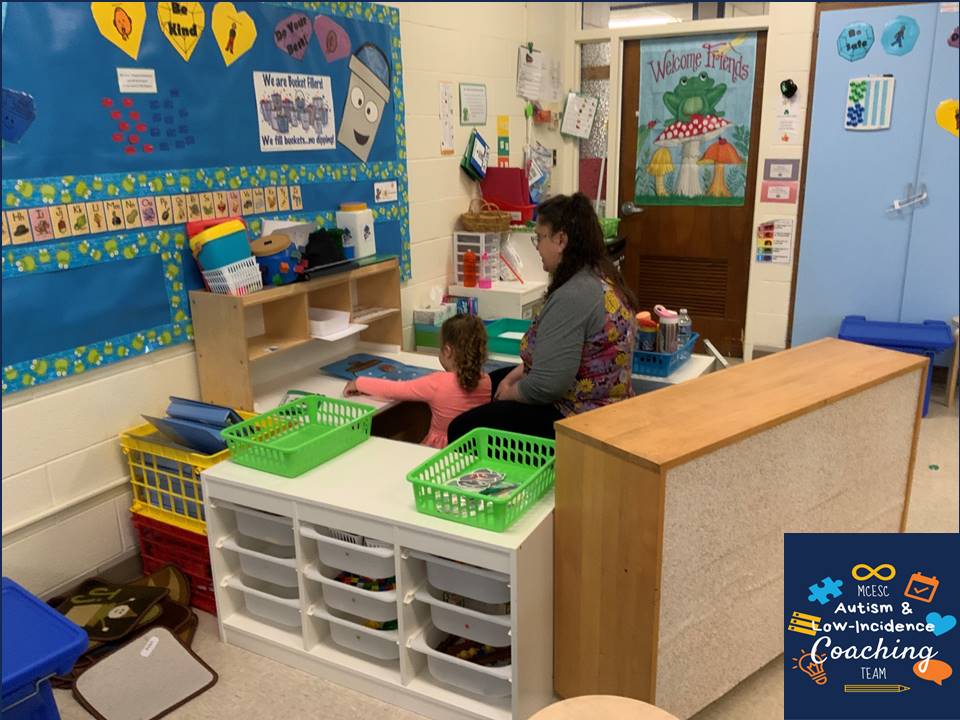
She also meets student sensory needs by using dividers to reduce distractions and visual clutter. 


The team works hard to model and facilitate functional communication across the day.  Amanda helps her staff understand the specific communication needs/goals for each of her students. With the help of the SLP, a variety of devices and AAC strategies are implemented.


Amanda is implementing so many of the evidence-based practices we recommend. We think she will be a great role model to show these important strategies in action.

Thanks for being such a wonderful extension of our team, Amanda!

Tuesday, February 27, 2024

Sensational Social Skills: Building Joint Attention During Instruction

Do you have a student who is hard to engage during instruction? Today's Sensational Social Skills post  will focus on Joint Attention strategies to help your students engage with you so you can teach them new skills. 

If you haven’t already seen our blog on the Foundation for Building Reciprocal Communication, check it out here: 

The Foundation for Building Reciprocal Communication

This blog will talk about the first steps when trying to engage with your student. Before you can expect your student to engage with you for instruction, you need to develop motivation, regulation, and basic self-management.


Once you have taken the time to build the foundation, you can determine what you want to teach your student and how to gain joint attention for the lesson. If your student struggles with joint attention, you want to start with something easy to build momentum.


One example is a preschool student who was new to the school environment. He struggled to engage with the adults and constantly tried to escape the environment and throw any item placed in his space.

  • The first goal was to create a space that provided clear visual and physical boundaries. A wide open space makes joint attention a challenge. Help to narrow the area the student is attending to at the moment using visual screens or strategically placed furniture. A cube chair provided physical boundaries. 
Lisa Turner & Katie Mlod
Mad River ECC, Mad River


  • Once this was established, the team focused on teaching the student to take the item placed in front of him, and instead of throwing it across the room, to place it in a bin. 
Denise Campbell
Mad River ECC, Mad River

  • Soon the student learned to pull a picture off Velcro and put it in a bin. Only one picture was on the page so it was an errorless task.

  • After practicing this basic skills in a structured environment, the student was able to participate during the preschool morning circle using an interactive circle time book.
Miranda Riggs
Mad River ECC, Mad River


Here are some other examples of strategies to support joint attention during instruction:

  • Use furniture to create physical boundaries 

Debi Gnau
Mad River ECC, Mad River

  • Use a bead box or pillbox to provide small edible treats for task completion. The student can match letters, numbers, or words to get a treat. These small edible reinforcers can allow quick and frequent reinforcement of those challenging or non-preferred tasks.
Debi Gnau
Mad River ECC, Mad River


  • Incorporate a fun anticipatory game to gain joint attention during instruction. For example, if using Pop-up Pirate or Jumping Jack (pictured below), the student gets to put in a sword or pull out a carrot for each small task. The anticipation of something popping unexpectedly may keep them engaged. 
Beth Young
Snyder Park Elementary, Springfield


  • Add personal interest information to assignments such as worksheets, taskboxes, or other activities
Dixie Middle School, New Lebanon

Michelle Barnhart
Bell Creek Intermediate, Bellbrook-Sugarcreek

Michelle Wade
Northridge Elementary, Northridge

Tim Cundiff
Greenville High School, Greenville


  • Prior to or during  instruction, gain joint attention through face-to-face physical interaction with  high-fives or these classic hand games: Patty Cake, Say Say Oh Playmate, Hand Slap


 Check out this article with more ideas and video examples:

 Care.com 8 Easy Hand Games for Kids


  • During whole group instruction or passive listening, provide instructional visuals for the student to manipulate.  
Rose Jepson
Northridge Elementary, Northridge

Makayla Barbar
Mad River ECC, Mad River

Genevieve Harvey
Walter Shade ECC, West Carrollton

Angie Whip
Northwestern Preschool, Northwestern

Amy Beanblossom
Arcanum-Butler, Arcanum


  • For non-speaking students, it is important to provide communication supports so that they have needed vocabulary readily available to engage in the activity. 
Emily Ottmar
Stevenson Elementary, Mad River


  • During instruction, use a pointer or light to direct the learner’s gaze to the target.

Try some of these strategies with your hard to engage student. It may take multiple tries before a strategy becomes effective. Keep in mind that what works for one learner may not work for all. And finally, always remember your foundation for joint attention: regulation, motivation, and basic self-management.

Tuesday, February 13, 2024

Academic Area: Predictable Chart Writing

Comprehensive Literacy Instruction is essential in today's classrooms, including self-contained classrooms and cross-categorical resource rooms. In many cases, reading and writing instruction has fallen by the wayside for our most complex learners however the push toward implementing the Science of Reading in all classrooms emphasizes the need for a shift. 

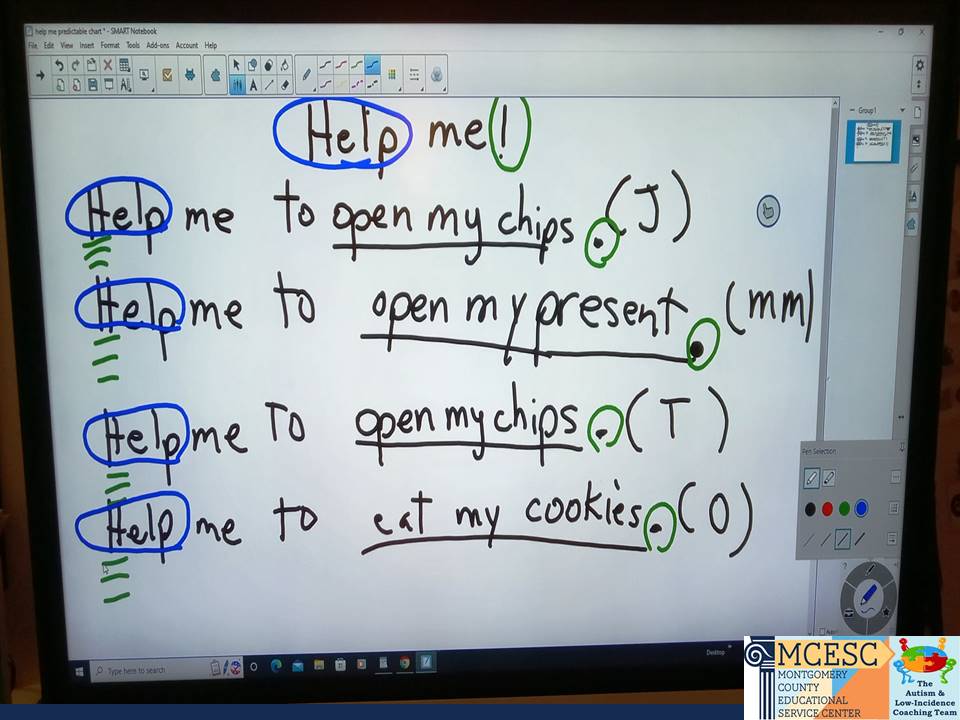
Shared Writing is one component of Comprehensive Literacy Instruction and a highly effective strategy for engaging students with complex needs in shared writing instruction is Predictable Chart Writing (PCW). PCW provides predictability, offers seamless integration of communication, and can be utilized as an activity for the entire classroom, small groups, or even individual sessions. Today's Academic Area post will break down the 5 steps to the Predictable Chart Writing routine. We want to extend a special thank you to Cynthia Resch at MCESC Learning Center-West for welcoming us into her classroom to model each step of the PCW routine for us to share!


Each step in the Predictable Chart Writing Routine takes place during a new session. Typically, this is done during daily writing instruction over the course of a school week. 


Step 1: Write the Chart (Monday)
  • Choose a sentence stem. Possible topics could include the current classroom theme, responding to a recent reading passage, or incorporating the use of core words. 
  • The students provide a personalized response to the sentence stem. 
  • Then, the teacher scribes the response on the chart while saying each part aloud.


  • Finally, the group will choral read each sentence when done. 
    • For non-speaking students, utilize AAC such as a big mack switch, communication board, or communication device to facilitate participation. See the example video below: 


Step 2: Reread the Chart (Tuesday)
  • First, the group will reread the entire chart chorally as the teacher points to each word.

  • Then, provide opportunities for individual students to find words such as a targeted core word or content vocabulary. 
  • Next, focus on a specific element (letter, word, convention) when done.
  • Finally, reread a final time.


Step 3: Work with Sentence Strips (Wednesday)
  • First, the group will reread the entire chart chorally as the teacher points to each word.
  • Next, pass out each student’s contribution to them on sentence strips. 
    • You can either prepare these sentence strips ahead of time or use this activity as an opportunity to model.
  • Then, demonstrate how to cut the sentence apart into words (after each cut, reread) and reorder.
  • Eventually, start reordering incorrectly to help students see if the sentence makes sense.
    • Allow students to make mistakes! These are opportunities to recheck work/check for what makes sense
  • After developing an understanding, students will cut apart their own sentences.


Step 4: Be the Sentence (Thursday)
  • First, the group will reread the entire chart chorally as the teacher points to each word.
  • Then, choose a sentence.
  • Next, write on a sentence strip, and then cut it apart.
    • You can either prepare these sentence strips ahead of time or use this activity as an opportunity to model.
  • Then, give each student a word from the sentence and have them physically arrange themselves to reorder the sentence
    • Repeat for 3-4 sentences.
  • Finally, end with a final choral reading of sentences.


Step 5: Make and Publish the Book (Friday)
  • First, the group will reread the entire chart chorally as the teacher points to each word.
  • Then, pass out individual sentences typed/written for book.
    • You can either prepare these sentence strips ahead of time or use this activity as an opportunity to model.
  • Next, students cut apart their sentences and reorder. 
    • Staff will guide students to self-edit by referring to the chart.
  • Then, they will glue their ordered sentence onto their paper. 

  • Next, students will add illustrations
    • They can use their own drawings or find pictures on Google images.
  • Finally, add the finished class book to classroom library.
    • You can also publish the class book to Tarheel Reader or Bookcreator.com for independent reading with technology or at home. 


To see Predictable Chart Writing in action with a group of learners at a variety of instructional levels, check out this video: 


For additional information on implementing Predictable Chart Writing in your classroom, we encourage you to check out these wonderful resources:

Online Modules
Books
Websites