Showing posts with label classroom layout. Show all posts

Tuesday, August 6, 2024

Free Pre-Recorded SpEd Hacks Webinars Available On-Demand

To kick off the year, we are featuring our pre-recorded SpEd Hacks webinars that can be viewed for free at your leisure. 

These sessions are about 75 minutes in length and focus on the following topics:
  • Classroom Layout and Environment
  • Team Building with Paraprofessionals
  • Scheduling
  • Planning for Instruction

They are a great fit for new or veteran teachers in a self-contained or cross-categorical classroom looking to get a handle on classroom organization and procedures to start the year off right!

Click the image below for access to the flyer which contains the registration links for each session. Once you register, you will be provided with the webinar recording link. 

Please note, due to the "on-demand" format of these sessions, we are unable to offer professional development hours from ACT, however many of our districts have issued their own certificates to provide CEUs to their staff for viewing our on-demand sessions. Please reach out to your district contact to coordinate this.

Feel free to share with colleagues and friends!


Tuesday, April 23, 2024

Regulation Rendezvous: Reduce Student Overwhelm with a Calming Classroom Environment

The school environment is full of stimuli that can add to overwhelm for autistic learners and those with learning and sensory processing differences. When overwhelmed, it can be hard for them to learn, apply skills, and cooperate with calming sensory supports. To avoid overwhelm, teachers can take a proactive approach by setting up a classroom environment that is calming and welcoming for students so that they feel safe and ready to learn. Today's Regulation Rendezvous provides examples of how you can Reduce Student Overwhelm with a Calming Classroom Environment.


Lighting
Overhead florescent lights can add to overwhelm because they are bright and directly overhead which can cause a glare on materials and worksheets. Additionally, some individuals are especially sensitive to the "hum" or "buzz" of these lights as well as any flickering that may occur. 

Reduce student overwhelm by using indirect lighting such as natural light from windows, string lights, or lamps.
Overhead String Lights and Lamps
Ashley Holtz
Kleptz ELC, Northmont

Light Cover
Tracey Cooper
Tecumseh, Clark ESC

Pendant Lights and Lamps
Jon Rowley
Smith Elementary, Oakwood

String Lights and Light Covers
Maggie Brackman
Northwood Elementary, Northmont


Visual Barriers
Items hanging on the wall, people walking around the classroom, and movement of staff and classmates can add to overwhelm because it can be visually distracting or even startle sensitive students. 

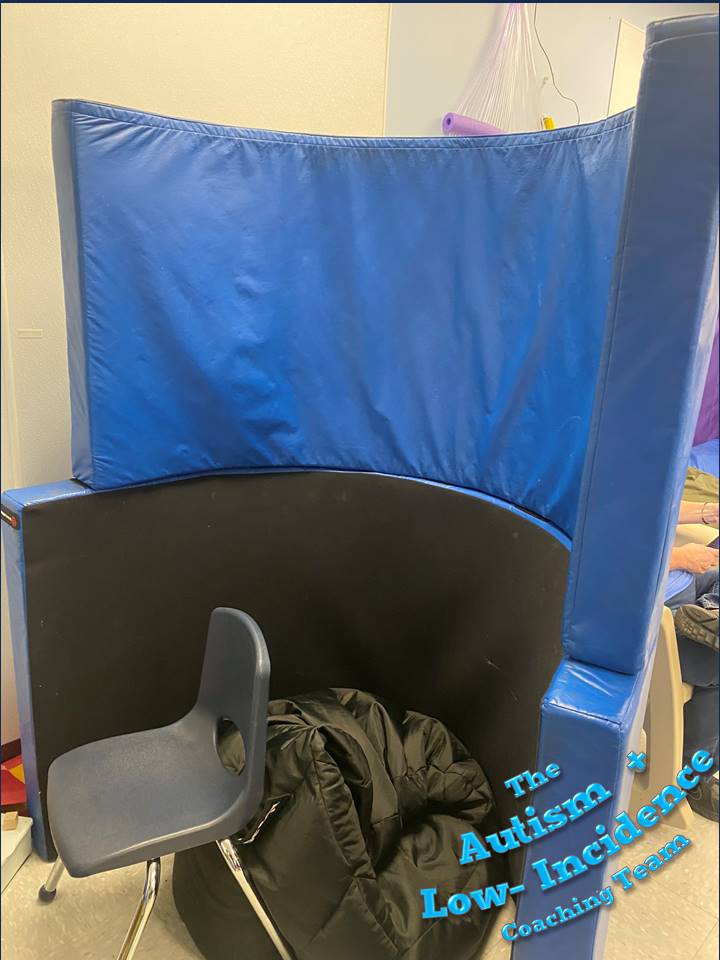
Reduce student overwhelm by using visual barriers such as dividers, study carrels, or individualized work spaces.

Portable Divider
Kathy Nance
Springfield

Student Work Space with Flexible Folding Mat Divider
Cindy Bowling
Dixie Elementary, New Lebanon

Portable Rolling Divider
Holly Smith
Nevin Coppock Elementary, Miami County ESC

Student Work Space With Physical Boundaries
Lauren Dickey
Indian Riffle Elementary, Kettering

Flexible Folding Mat Divider
Amanda McCormick
Driscoll Elementary, Centerville

Portable Rolling Divider
Driscoll Elementary, Centerville

Room Divider
Cassandra Hebauf
Northmoor Elementary, Northmont


Additionally, cover open storage, use consistent storage bins, and cover distracting items or displays within the classroom. 
Covered Interactive Whiteboard
Jackie Vollmer
Driscoll Elementary, Centerville

Anchor Chart Bulletin Board with Curtain Rod

Covered Phone with Flexible Folding Mat
Rylie Jarrett
Stevenson Elementary, Mad River

Covered Storage
Taylor Ruef
Stevenson Elementary, Mad River

Student Covered with Blanket
Nicole Bellard
Fairview Elementary, Dayton


Classroom Calming Space
When extremely overwhelmed, a student's fight or flight reflex may be activated leading to aggressive behaviors, hiding, or eloping out of the classroom. 

Reduce student overwhelm by providing a safe, calming space within the classroom where students can go to escape overwhelming stimuli and regulate. 

 
Student Home Base/Safe Space
MaKynzie Lowery
Learning Center-West, MCESC

Classroom Calming Corner
MaKynzie Lowery
Learning Center-West, MCESC


Calming Classroom Environment Decor
Julia Millikin
Milton Union Elementary, Milton Union


Classroom Calming Spot
Kendra Krumpe
EJ Brown Middle School, Dayton

Wall Mural Station
Deanna Granroth
Wogaman Middle School, Dayton


For more information regarding calming classroom setup, check out our previous posts:


Tuesday, October 11, 2022

Regulation Rendezvous: Even More Classroom Calming Sensory Spaces

Schools are sensory-rich environments and dealing with the myriad of sensory information within the school setting can be very challenging for a student with autism. When a student with autism experiences sensory overload, they may get overwhelmed resulting in behaviors or meltdowns. One strategy to avoid or help a student recover from a meltdown includes the use of a calming sensory space. Today's Regulation Rendezvous will provide suggestions for the appropriate use of a calming sensory space in the classroom.

  • A calming sensory space should be a specific location within the classroom where the student feels safe, comfortable, and typically has minimal alerting sensory input such as decreased lighting and noise.
Heather Clark
Saville Elementary, Mad River

Jessica Wright
Smith Elementary, Oakwood

Rylie Jarrett
Stevenson Elementary, Mad River


YPH Classroom
East Elementary, Eaton

Ashlee Nicols
Brookville Elementary, Brookville

Maggie Brackman
Northwood Elementary, Northmont

Betsy Seger
Miami East Junior High, Miami East

Jolynne Rodgers
Mad River ECEC, Mad River

Lauren Dickey
Indian Riffle Elementary, Kettering


  • It may contain items to facilitate self-calming such as a beanbag chair or a weighted blanket.
Rebecka Stricker
Springcreek Primary, Piqua

Rylie Jarrett
Stevenson Elementary, Mad River


  • The location of a calming sensory space can be within a designated area of the classroom or in an enclosed area with less sensory stimuli. 
YPH Classroom
East Elementary, Eaton

Debi Gnau
Mad River ECEC, Mad River

Deanna Hicks
East Elementary, Eaton

Megan Logano
Clark County ESC

Lauren Dickey
Indian Riffle Elementary, Kettering

Rhonda Brunk
Trotwood ELC, Trotwood


  • The use of a calming sensory space can be recommended by a staff member or initiated by the student.
Haley Urschel
Perrin Woods Elementary, Springfield


  • Going to a calming sensory space should be viewed in a positive way and not associated with punishment or “time out”.
Rebekah Foust
Mad River ECEC, Mad River

  • A calming sensory space is a place where a student can plan or review daily events, assist in managing stressors from the environment, or regain control if a meltdown has occurred. Visual supports can be helpful.
Granville Bastin
Preble County ESC

YPH Classroom
East Elementary, Eaton

For more examples of Calming Sensory Spaces don't miss our previous posts: