Thursday, August 9, 2018

Organization Station-- Classroom Layout

August is in full swing and many of our teams are busy preparing for students to arrive soon. We wanted to focus today's Organization Station on one of the first steps of organizing the classroom and that is Classroom Layout.


When planning your classroom layout, it is important to plan ahead. The classroom should have clearly defined locations for the followng:
  • whole group instruction
  • small group instruction
  • one-on-one instruction
  • structured/independent work
  • free time/indoor recess/reward breaks
  • sensory breaks
  • technology
There may be some age-specific areas included in your classroom layout as well. For instance, preschool classrooms may have areas for dramatic play, naps, and sensory play while high school classrooms may have areas for vocational tasks. 


In some classes, an area of the classroom may need to serve multiple purposes such as using a kidney table for whole group or for small group depending on the time of day. Below we have compiled some of the best examples we have seen across the Miami Valley for each location.

Whole Group Instruction
Many teams at the preschool or elementary level have a carpet area for whole group activities such as GoNoodle, calendar, or whiteboard activities.
Angela Crum
Fairbrook Elementary, Beavercreek

Keelin DiMuccio
Fairbrook Elementary, Beavercreek

Emily Ottmar
Stevenson Elementary, Mad River

A large table, such as a kidney table, is also a great place for whole or small group instruction.


Small Group Instruction


One-on-One Instruction
Jessica Ward
Rolling Hills Elementary, Northeastern

Jamie Minnish
Prass Elementary, Kettering

Rebecca Lemons
Miamisburg Middle School, Miamisburg


Structured/Independent Work
Larger classrooms can often accommodate for each student to have their own work space.
Pandy Pugh
Indian Riffle Elementary, Kettering


Smaller classrooms may need to have a designated independent work station if they do not have the room for every student to have their own work space.
Carrie Prickett
Jane Chance Elementary, Miamisburg
Taylor Ruef
Stevenson Elementary, Mad River


Free Time/Indoor Recess/Reward Breaks
Designating where students should spend play and leisure time as well as clearly communicating when they are allowed to play is an important classroom management strategy.
Jessica Ward
Rolling Hills Elementary, Northeastern

Toni Mallott
Jane Chance Elementary, Miamisburg

Taylor Ruef
Stevenson Elementary, Mad River

Jamie Minnish
Prass Elementary, Kettering

Brittany Sword
Valley Elementary, Beavercreek


Sensory Breaks
Many students benefit from a quiet area where they can get a break from the sensory demands of the classroom. In some buildings, this may be a designated room. When a building does not have this space available or when a teacher wants an area that is quickly accessible, they may create a sensory space within the classroom.

Pandy Pugh
Indian Riffle Elementary, Kettering

Kendall Koehler
Normandy Elementary, Centerville 
Keelin DiMuccio
Fairbrook Elementary, Beavercreek


Traci Parker
Forest Elementary, Troy

Bobbi Jo Chapman
Snyder Park Elementary, Springfield

Jamie Zimmer
Kettering Middle School, Kettering
 For some students, a quiet location within the room with reduced visual stimuli is helpful.
Beth Young
Snyder Park Elementary, Springfield

Technology
Some classrooms have a designated location for technology such as a computer station or iPad area.
Jennifer McGowan
Smith Middle School, Vandalia
Peggy Ristau
Brookville Intermediate, Brookville


Other classrooms have technology stored in a designated location and when it is time for students to use the technology they can take it to another area.
Megan Kelly
Beavertown Elementary, Kettering


It is important when dividing up the classroom into clearly defined locations to use visual and physical boundaries. Sometimes these are static such as positioning of furniture or shelving. Other times, we see teams use portable dividers that can be adjusted throughout the day based on the number of locations being used and distractibility of students.
Laurie Maravetz
Schaefer Middle School, Springfield

Ramel Mitchell
Kyle Elementary, Troy 
Marissa Calhoun
Fairbrook Elementary, Beavercreek


Jamie Minnish
Prass Elementary, Kettering

Before moving furniture around, consider creating a layout plan. You can create a plan in Powerpoint or visit one of these free online resources:


Tuesday, August 7, 2018

Around Town Round Up-- Reinforcement for Task Completion

Reinforcement is an essential component to motivating students with ASD and other disabilities. It increases the likelihood that the student will perform a target skill or behavior in the future. Task completion is an important target skill for many students and therefore we have found a variety of great reinforcement systems related to task completion to feature on today's Around Town Round Up. These examples include a variety of ability and grade levels and can be modified to meet the needs of any learner.


Some work completion reinforcement systems use pictures and words to correlate with the tasks needing to be completed. In this example, students complete the activities pictured on the left and move them to the right as they are finished. At the end, they get a free choice period symbolized by the question mark card.
Susie Stoner
Bradford Elementary, Bradford

These picture icons correspond with taskboxes to be completed before the student gets the chosen keyboard toy.
Lindsey Woods
Fairborn Primary, Fairborn


For older students or students with strong reading skills, task lists can be used to communicate what tasks need to be completed.
Robbie Whorton
Trotwood-Madison HS, Trotwood

Emily Ottmar
Stevenson Elementary, Mad River Local Schools

Some reinforcement systems use tokens to symbolize the number of tasks to be completed. Tokens can be removed as the task is finished.
Jennifer McGowan
Smith Middle School, Vandalia

Brittany Sword
Valley Elementary, Beavercreek


Visual Supports provide structure for students to know what items or activities they can work for. Choice boards can be at a designated break location or they may be part of the reinforcement system visual supports.

Emily Ottmar
Stevenson Elementary, Mad River Local Schools

Jennifer McGowan
Smith Middle School, Vandalia

Lindsey Woods
Fairborn Primary, Fairborn
Don't miss out on our other posts for Reinforcement Systems!

Monday, May 21, 2018

ALIST Spotlight-- Brittany Sword, Valley Elementary, Beavercreek

Another one of our fabulous new inductees into our ALIST (Autism and Low Incidence Support Team) is Brittany Sword at Valley Elementary in Beavercreek City Schools. Prior to our coaching, Brittany already had tons of great supports for her students already in place. There is evidence of best practice teaching everywhere you look in Brittany's classroom so we have so many great ideas to share in today's ALIST Spotlight.


Brittany has done an excellent job arranging her room with clear physical boundaries to help students know where they need to be and to help limit wandering.


Brittany increases this physical structure using flexible dividers which is a wonderful support for students who struggle to stay in the designated learning area or who may be easily distracted by the sensory-rich classroom environment.

In addition to physical supports, Brittany uses location-based interactive visual schedules to help students with transitions and to provide the expectation of where they need to be. Students take a schedule card off their schedules and place them in the cup at the corresponding location.

Her schedules are some of the most well differentiated schedules we have ever seen! Difficulty ranges from matching color cards to the schedule location color, matching picture icons, or matching words. 


Brittany is also a master at differentiating learning activities. For her circle time, Brittany uses the Interactive Calendar Activities from Autism Adventures. These activities range from a simple calendar book, a calendar file folder, or a daily calendar worksheet. The floor desks are a great tool for students who are sitting at circle time and need a surface for completing activities. 


Another way Brittany differentiates is through use of the STAR Program. The STAR program provides monthly thematic activities which Brittany modifies further to meet her student needs. Brittany's students are learning higher level vocabulary through activities they can easily access. For one planet lesson, students matched pictures through individual cards or a velcro worksheet or matching words to pictures through a file folder or a velcro worksheet. Students were engaged and excited and Brittany shared that she provides students with multiple opportunities to work on these activities to increase their understanding.

Brittany's use of the STAR Program carries over to her calendar time through correlating visual supports for the calendar numbers.

Brittany also uses visual supports to communicate activity expectations through the use of visual routines or mini-schedules.


This mini-schedule is used when students work independently in the structured work system area. Students match the picture icon to the corresponding bin or baggy to collect their work tasks for the day.


Visual supports are great for staff too! We love these great fine motor bins that can be used as morning work or anchor activities. The pocket chart shows which bin each student is working on and the easy lesson plan outlines the assigned activities for each day for quick resetting of the pocket chart.


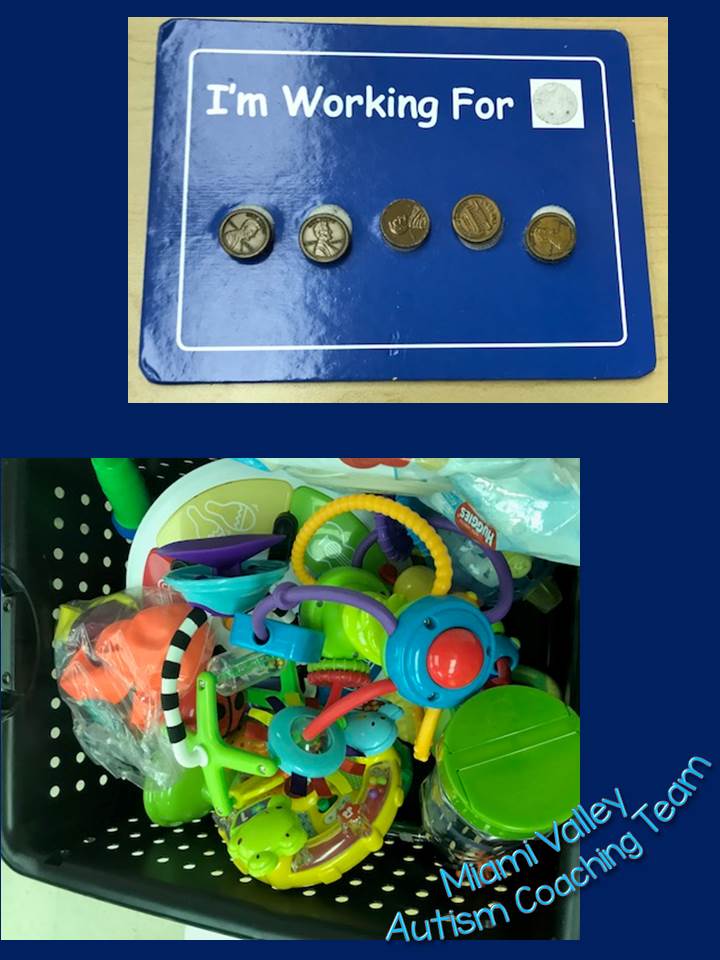
We were also impressed with how effectively Brittany incorporates continuous reinforcement for her students who need frequent motivators. At the start of an activity, the student chooses a toy to work for. The basket has all of their favorite toys so that they are portable and easy for staff to access. While working, the student removes a penny token for every repetition completed. Tasks include materials from the STAR Program, imitation activities, and taskbox activities such as the pictured lunch tray activity. After all 5 pennies are removed, the student gets to play with the chosen toy for several minutes before the sequence is repeated. This quick succession of repetitions and reinforcement makes work time productive and motivating. 


Despite the quick pace of 1:1 instruction and variety of differentiated tasks completed during group time, Brittany also keeps up on her progress monitoring using these awesome data sheets. 

With all of these fantastic supports in place it is evident why Brittany is a great fit for our ALIST!